Unleash Your Research Superpowers with Elicit: The AI Research Assistant
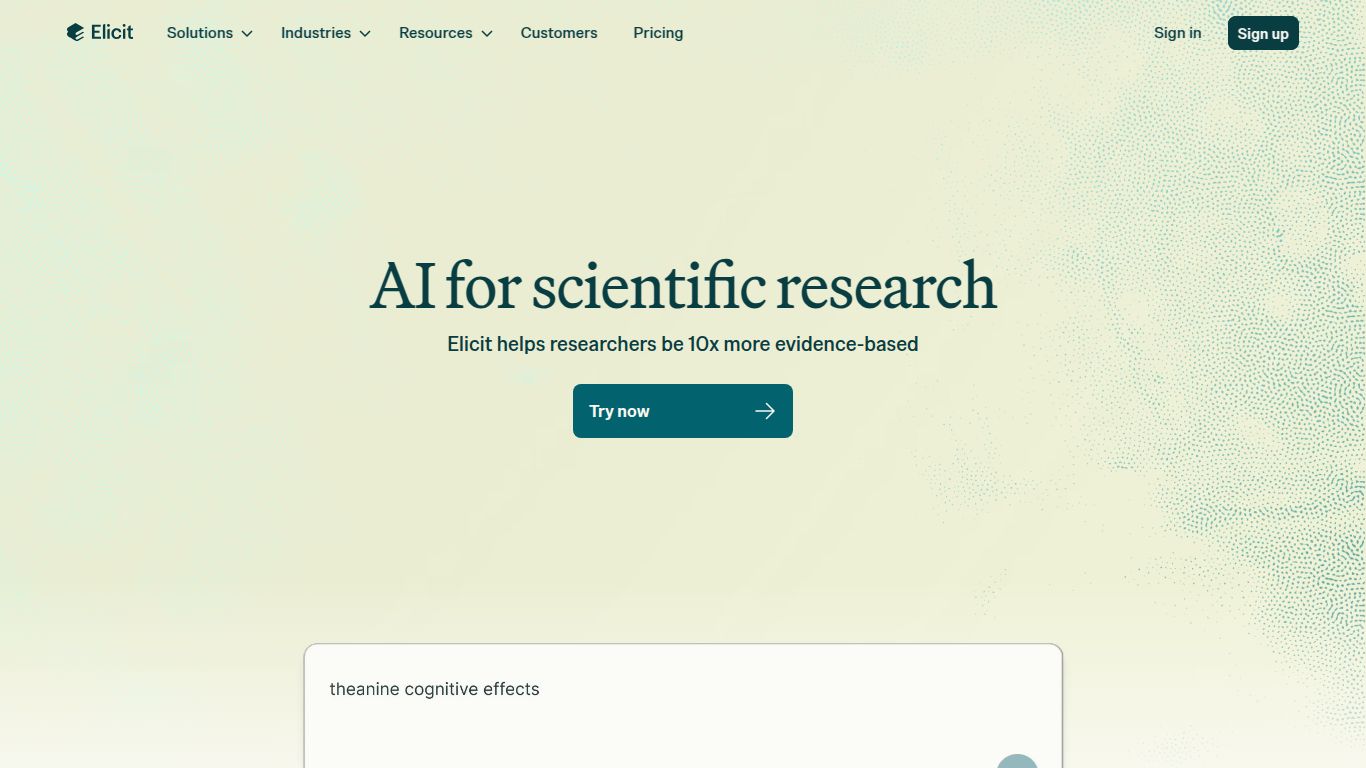
Are you spending countless hours sifting through dense academic papers, struggling to connect the dots and synthesize findings? Say goodbye to the grind and hello to your new research partner, Elicit. Developed by the non-profit research lab Ought, Elicit is an intelligent assistant designed to automate and accelerate the most time-consuming parts of a literature review. It goes beyond simple keyword searches to truly understand your research questions, helping you uncover relevant studies, extract key data, and synthesize information in a fraction of the time.
Elicit’s Core Capabilities
Elicit is a master of text-based research and analysis. It doesn’t generate images or videos; instead, it focuses entirely on processing and understanding academic literature to provide you with actionable insights. Its primary capabilities include:
- Intelligent Literature Search: Ask a research question in natural language, and Elicit finds relevant papers even if they don’t use your exact keywords.
- Automated Summarization: Get concise, one-sentence summaries of a paper’s abstract, or even a synthesized summary of the top findings related to your query from multiple papers.
- Structured Data Extraction: This is Elicit’s secret weapon. It can scan dozens of papers and pull specific information—like interventions, outcomes, population characteristics, or dosage—into a clean, organized table for easy comparison.
- Research Brainstorming: Stuck on where to go next? Elicit can help you brainstorm new research questions based on a collection of papers.
Key Features That Drive Discovery
Elicit is packed with features that create a seamless and powerful research workflow:
- 🔎 Find Papers Workflow: The primary function where you pose a question and Elicit returns a list of relevant papers, complete with summaries and details extracted from the abstract.
- 📊 Customizable Columns: You’re in control. Add columns to your results table to ask Elicit to find specific pieces of information from each paper, transforming hours of manual data entry into a few clicks.
- 📚 Upload Your Own PDFs: Already have a library of papers? Upload them directly to Elicit to search, summarize, and extract data from your personal collection.
- 🔗 Citation & Export: Easily export your findings and tables to CSV or BIB formats, making it simple to integrate Elicit’s work into your writing and citation management tools.
Elicit Pricing: A Plan for Every Researcher
Elicit offers a flexible pricing structure to suit different levels of research intensity. All plans are based on a credit system, where different tasks consume a certain number of credits.
- Basic (Free): A fantastic starting point! You get a one-time grant of 5,000 credits to test out all the core features. Perfect for occasional users or for seeing if Elicit fits your workflow.
- Plus: For the dedicated researcher. Priced at $12 per month (or $10/month when billed annually), this plan gives you 12,000 credits each month. This is ideal for graduate students and professionals conducting regular, in-depth research projects.
- Institutions & Enterprise: Custom plans with bulk credits, centralized billing, and priority support are available for research teams, labs, and entire universities.
Who is Elicit For?
Elicit is a game-changer for anyone whose work relies on a deep understanding of academic literature. This includes:
- 🎓 Academic Researchers & Professors: Accelerate literature reviews for new papers and grant proposals.
- 👩🎓 PhD & Graduate Students: Drastically cut down the time spent on dissertation and thesis research.
- 🔬 Medical and Scientific Researchers: Systematically review evidence and stay on top of the latest findings in your field.
- 📈 Policy Analysts & Consultants: Quickly gather evidence from academic studies to inform reports and decision-making.
- 💼 R&D Professionals: Track innovations and vet technical information from scientific papers.
Elicit Alternatives & Comparison
How does Elicit stack up against other popular research tools? Here’s a quick breakdown:
Elicit vs. Consensus
Consensus is excellent for getting quick, direct answers to questions, backed by a snippet from a relevant study. It’s like a search engine for scientific findings. Elicit, on the other hand, is built for comprehensive, systematic reviews. It shines when you need to compare dozens of papers on multiple criteria and extract structured data into a table.
Elicit vs. Scispace
Scispace (formerly Typeset) offers a wide range of features, including an AI-powered PDF reader, paraphrasing tools, and formatting assistance. It’s an all-in-one research platform. Elicit maintains a laser focus on the initial discovery and synthesis phase, offering a more powerful and automated workflow for finding papers and extracting data than Scispace’s more generalized toolkit.
Elicit vs. ResearchRabbit
ResearchRabbit is a fantastic tool for visual discovery, creating beautiful maps of papers to help you explore citation networks and find seminal works. It’s about “following the breadcrumbs.” Elicit is fundamentally different; it reads and understands the content of the papers to answer your specific questions, making it a tool for analysis rather than just discovery.