Microsoft Agent Framework

3wks agoupdate 45 0 0

Successor to AutoGen/Semantic Kernel for building and orchestrating multi-agent workflows.

Collection time:
2025-10-26
Microsoft Agent FrameworkMicrosoft Agent Framework

Microsoft Agent Framework: Build Your Own Autonomous AI Agents

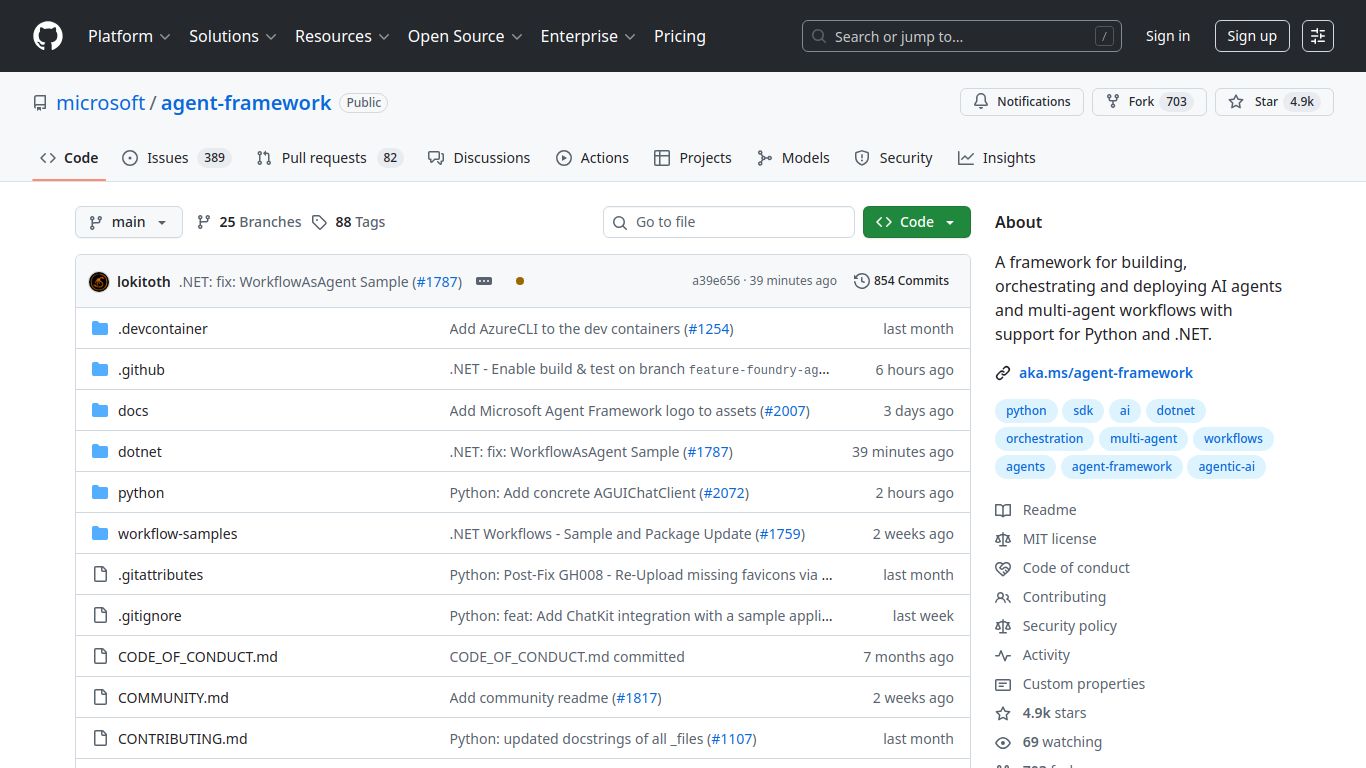
Unleashed by the tech giant Microsoft, the Microsoft Agent Framework is not just another AI tool; it’s a powerful, experimental canvas for developers to build and run their own autonomous AI agents. Think of it as the ultimate toolkit for creating smart assistants that can reason, plan, and execute complex tasks across various digital environments. This open-source project, available on GitHub, empowers developers to construct sophisticated agents that can interact with APIs, web services, and other digital tools to achieve specific goals, moving beyond simple chatbots into the realm of true automated problem-solvers.
Microsoft Agent Framework

Core Capabilities: A Universe of Integration

The true power of the Microsoft Agent Framework lies in its ability to orchestrate, not just perform. It doesn’t have native “image generation” but can seamlessly command an agent to use a tool like DALL-E. Its capabilities are defined by the tools you connect it to.

  • Advanced Text & Language Processing: By integrating with powerhouse Large Language Models (LLMs) like those from OpenAI or Azure, agents built with this framework can understand complex queries, summarize vast amounts of information, generate human-like text, and perform sophisticated language translations.
  • limitless Tool Integration: This is its killer feature. You can equip your agents with the ability to connect to virtually any API. This means they can perform actions like sending emails, managing calendar events, fetching real-time stock data, or even triggering image and video generation through external services.
  • Web Interaction & Data Scraping: Deploy agents that can browse the web, extract specific information from websites, fill out forms, and interact with web applications, automating tasks that would typically require manual human effort.
  • Complex Workflow Orchestration: The framework excels at managing multi-step processes. An agent can be designed to first research a topic online, then synthesize the findings into a report, and finally email that report to a specified list of recipients, all without human intervention.

Standout Features: What Makes It Tick?

  • Event-Driven Architecture: Agents operate on a responsive, event-driven model. They react to new information or triggers, making them highly dynamic and adaptable to changing environments.
  • Modular and Extensible Design: Think of it like building with high-tech LEGO blocks. Developers can easily create and plug in new “tool” modules, continuously expanding their agents’ skills and capabilities over time.
  • Robust State Management: For long and complex tasks, agents need a memory. The framework provides solid state management, allowing agents to remember context and track their progress through multi-step workflows.
  • Powerful Orchestration Engine: At its core is an orchestrator that acts as the conductor of an AI symphony. It intelligently coordinates between the LLM’s reasoning, the agent’s plan, and the execution of various tools to ensure goals are met efficiently.

Pricing: Surprisingly Accessible

Free and Open-Source

The Microsoft Agent Framework itself is completely free. As an open-source project on GitHub, developers can download, modify, and use it in their projects without any licensing fees from Microsoft. This makes it an incredibly cost-effective foundation for building custom AI solutions.

Usage-Based Costs

While the framework is free, the operational costs will depend on the services you connect it to. Your primary expenses will be the API calls made to your chosen Large Language Model (e.g., OpenAI’s GPT-4 or Azure OpenAI Service) and any other third-party paid APIs your agent utilizes. Hosting costs for running the agent would also apply if deployed on a cloud server.

Who Should Use Microsoft Agent Framework?

This is a tool designed for builders and innovators. The primary audience includes:

  • AI Developers & Software Engineers: Professionals looking to build custom, agentic AI applications from the ground up.
  • Solution Architects: Those designing complex, automated systems for enterprises that require intelligent agent integration.
  • AI Researchers: Academics and R&D professionals experimenting with the frontiers of autonomous systems and multi-agent collaboration.
  • Tech Startups: New companies aiming to create disruptive products powered by sophisticated AI agent technology.
  • Enterprise Automation Teams: Groups focused on automating complex internal workflows, data processing, and business intelligence tasks.

How It Compares: Microsoft Agent Framework vs. The Competition

vs. LangChain

LangChain is a more mature and widely adopted framework with a massive ecosystem of integrations. It’s an all-purpose toolkit for building LLM applications. The Microsoft Agent Framework, while newer, offers a more focused and potentially more structured approach specifically for event-driven, orchestrated autonomous agents, carrying the weight and architectural patterns of a major tech corporation.

vs. AutoGen

Interestingly, AutoGen is also a Microsoft project. The key difference is the focus. AutoGen is purpose-built for creating a “society” of conversational agents that collaborate by “talking” to each other to solve problems. The Agent Framework is more of a general-purpose orchestrator for a single (or multiple) agent’s actions and tool use, focusing on the event-driven execution of tasks.

vs. CrewAI

CrewAI excels at creating collaborative agent “crews” with specific roles (e.g., a Researcher Agent, a Writer Agent, a Reviewer Agent) that work together on a task. It’s highly focused on this role-playing, assembly-line model. Microsoft’s framework is a lower-level, more foundational tool that could be used to build a system *like* CrewAI, offering more flexibility but requiring more setup.

data statistics

Relevant Navigation

No comments

none
No comments...