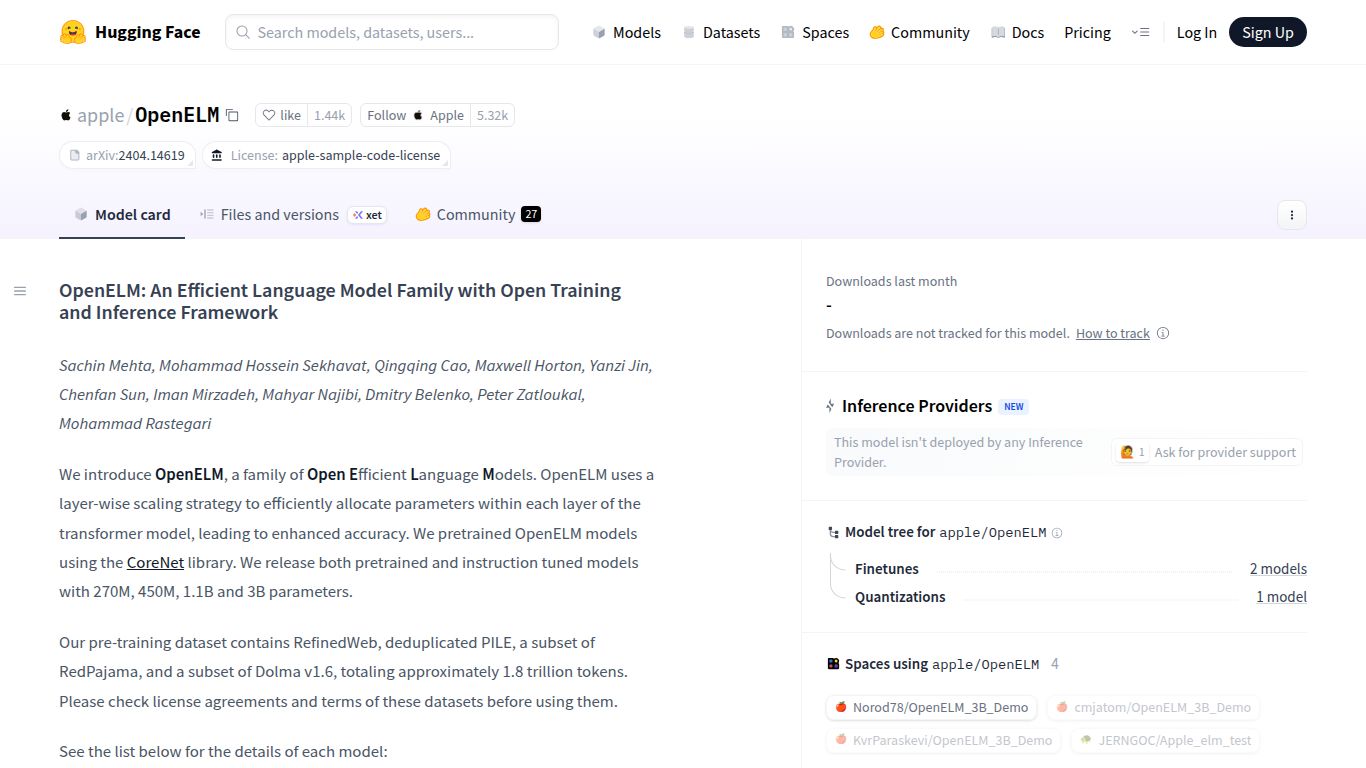
From the minds at Apple comes OpenELM, a groundbreaking family of open-source, efficient language models designed to redefine on-device artificial intelligence. Unlike massive, cloud-based models that require a constant internet connection, OpenELM (Open-source, Efficient Language Models) is specifically engineered to run directly on your devices, such as iPhones, iPads, and Macs. This on-device approach delivers unprecedented speed, privacy, and responsiveness, empowering developers to build smarter, faster, and more secure applications. It represents a major step by Apple into the open-source AI community, providing a powerful toolkit for creating next-generation experiences.
Capabilities
As a foundational language model, OpenELM’s primary capability is its mastery over text and code. It excels at a wide range of language-based tasks without needing to send your data to a server. While it doesn’t natively generate images or video, it serves as the intelligent “brain” that can power applications with those features.
- Text Generation & Summarization: Effortlessly draft emails, compose articles, summarize long documents, and generate creative text right on your device.
- Language Understanding: It can analyze, classify, and extract information from text, making it perfect for sentiment analysis or data organization tools.
- Coding Assistance: Developers can use OpenELM for code completion, debugging, and generating code snippets in various programming languages.
- Conversational AI: It can be the engine behind highly responsive and private chatbots or virtual assistants that work offline.
Key Features
- On-Device Performance: This is OpenELM’s superpower. By running locally, it offers blazing-fast response times and ensures your personal data remains completely private and secure on your device.
- Scalable Model Sizes: OpenELM is not a one-size-fits-all model. It comes in various sizes (from 270 million to 3 billion parameters), allowing developers to choose the perfect balance of performance and resource usage for their specific application.
- State-of-the-Art Efficiency: Apple employed a novel layer-wise scaling strategy, which means each layer of the model is optimized for maximum efficiency. This allows OpenELM to achieve impressive performance with fewer parameters than competing models.
- Complete Open-Source Transparency: Going beyond just releasing the model, Apple has also provided the complete framework for training and evaluation, including training logs and multiple checkpoints. This transparency fosters trust and encourages community-driven innovation.
Pricing
One of the most attractive aspects of Apple OpenELM is its pricing: it is completely free. As an open-source project released under the Apple Sample Code License, developers and researchers can download, modify, and integrate the models into their projects without any subscription fees or licensing costs. The only “cost” is the computational power required to run the models, which is precisely what OpenELM is designed to minimize.
Who Is It For?
- Mobile & Desktop App Developers: Especially those in the Apple ecosystem who want to build intelligent, privacy-first features into their iOS, macOS, or iPadOS applications.
- AI Researchers & Academics: Professionals who want to study the architecture and training methods of highly efficient language models.
- Hobbyists & AI Enthusiasts: Individuals eager to experiment with cutting-edge AI on their personal devices without relying on expensive cloud APIs.
- Privacy-Conscious Professionals: Users who need powerful text-processing tools but are unwilling to compromise on data security by sending sensitive information to third-party servers.
Alternatives & Comparison
OpenELM enters a competitive field of efficient, open-source language models. Here’s how it stacks up:
- Google Gemma: A family of lightweight models from Google. Gemma is a strong competitor, but OpenELM is specifically architected with a focus on on-device performance and efficiency, potentially giving it an edge in resource-constrained environments like mobile phones.
- Microsoft Phi-3: Microsoft’s series of small language models (SLMs) are known for their high quality and reasoning capabilities. The choice between Phi-3 and OpenELM may come down to the specific task and ecosystem, with OpenELM being a natural fit for Apple-centric development.
- Meta Llama 3 (8B): While slightly larger, the smallest version of Llama 3 is a powerful open model. OpenELM’s key advantage is its smaller footprint and optimization for direct, on-device execution where even an 8B model might be too large.
In summary, while alternatives exist, Apple OpenELM’s core differentiator is its laser focus on unparalleled efficiency and privacy for on-device applications, making it a game-changer for the future of mobile AI.