DBRX Instruct: Databricks’ Open-Source Powerhouse for Text and Code
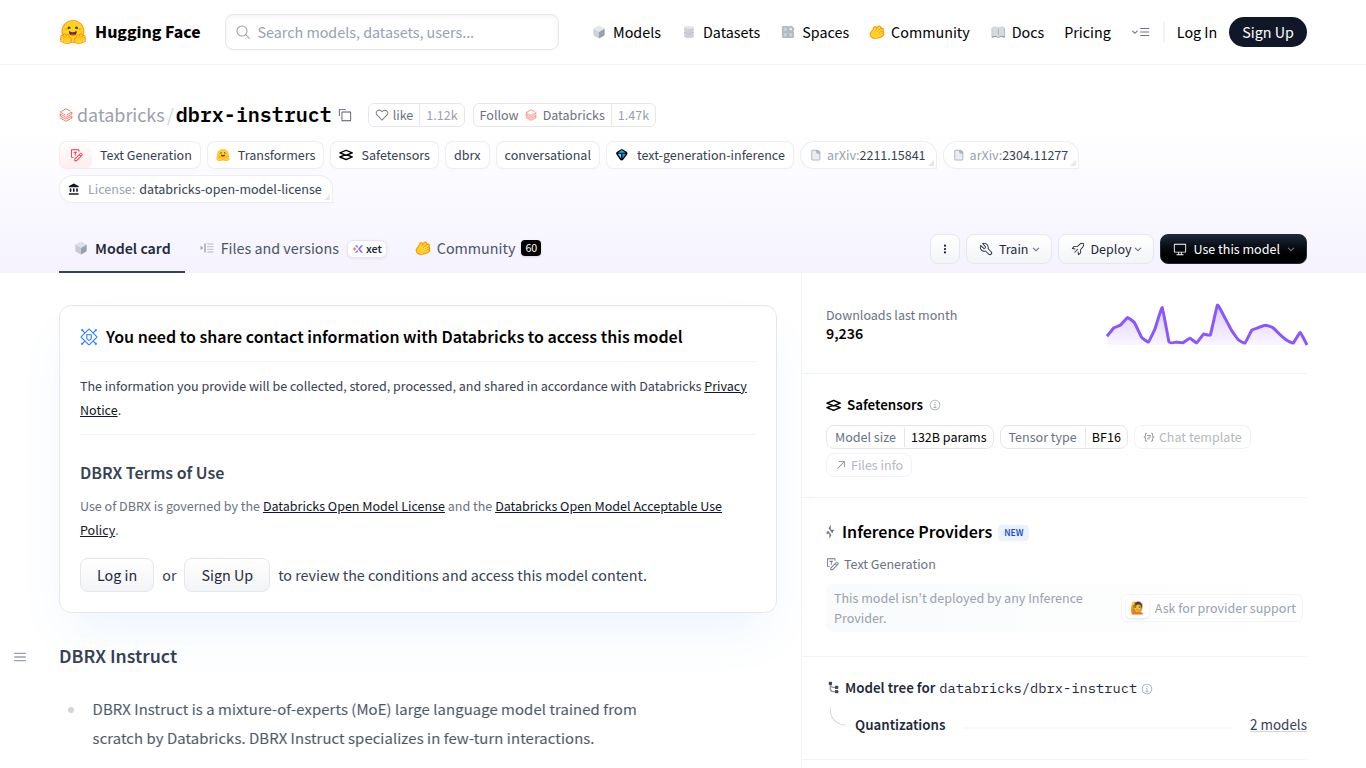
Welcome to the deep dive on DBRX Instruct, a cutting-edge large language model (LLM) developed and open-sourced by the data and AI experts at Databricks. DBRX Instruct isn’t just another model; it’s a state-of-the-art, instruction-tuned powerhouse designed to excel at a wide range of natural language and coding tasks. Built on a sophisticated Mixture-of-Experts (MoE) architecture, it delivers top-tier performance with remarkable efficiency, making it a formidable contender in the open-source AI landscape and a compelling alternative to proprietary models.
Core Capabilities
It’s crucial to understand that DBRX Instruct is a specialist in the realm of language and code. Its capabilities are laser-focused on textual and symbolic reasoning. Here’s a breakdown of what it can and cannot do:
- Text Generation: Absolutely. DBRX excels at creating high-quality, coherent text for any purpose, from writing articles and emails to generating creative stories and marketing copy.
- Code Generation: Yes, this is a major strength. It can write, debug, explain, and translate code in numerous programming languages, serving as a powerful assistant for developers.
- Summarization & Analysis: It can effortlessly condense long documents, research papers, or articles into concise summaries and extract key information.
- Question Answering: With its vast knowledge base, it can provide detailed answers to complex questions on a wide array of topics.
- Image Generation: No. DBRX Instruct is a text-only model and does not have the ability to create or process images.
- Video & Audio Generation: No. Similar to images, it does not operate on video or audio modalities.
Key Features
What sets DBRX Instruct apart from the crowd? It’s all in the architecture and performance philosophy.
- Mixture-of-Experts (MoE) Architecture: Unlike dense models that activate all their parameters for every task, DBRX uses a “team of specialists.” It intelligently routes your request to the most relevant “expert” neural networks within its structure. This makes inference incredibly fast and cost-effective without sacrificing quality.
- State-of-the-Art Performance: Databricks has benchmarked DBRX Instruct extensively, showing it outperforms other leading open-source models like Llama 2 and Mixtral on language understanding, programming, and math benchmarks.
- Large Context Window: With a 32,000-token context window, DBRX can process and recall information from very long documents or conversations, making it ideal for complex tasks like legal document analysis or maintaining long-running chat sessions.
- Truly Open Source: Released under a permissive license, DBRX gives developers and enterprises the freedom to use, modify, and deploy the model on their own infrastructure, ensuring data privacy and full control.
Pricing and Access
As an open-source model, DBRX Instruct is free to download and use. However, the “price” comes from the computational resources required to run it (known as inference). Here’s how you can access it:
- Self-Hosting: If you have the necessary hardware (powerful GPUs), you can download the model from Hugging Face and host it on your own servers for maximum privacy and control.
- Cloud Platforms: The easiest way for most users. You can access DBRX through various platforms that offer model-as-a-service APIs, including the Databricks platform itself, Hugging Face, Perplexity, and other cloud providers. Pricing on these platforms is typically pay-as-you-go, based on the number of tokens processed.
- No Subscriptions: Unlike proprietary tools like ChatGPT Plus, there is no fixed monthly subscription fee for the model itself. You only pay for what you use, which can be far more economical for certain usage patterns.
Who is DBRX Instruct For?
DBRX is a versatile tool that caters to a wide range of technical and enterprise users:
- AI/ML Developers and Engineers: The primary audience. They can integrate DBRX into applications, fine-tune it on proprietary data, or use it as a powerful coding assistant.
- Enterprises: Companies looking to build custom AI solutions on a secure, private, and powerful open-source foundation will find DBRX to be a compelling option.
- Data Scientists: Useful for automating data analysis reporting, generating scripts for data manipulation, and exploring complex datasets through natural language queries.
- Researchers: Academics and AI researchers can use DBRX to study MoE architectures and push the boundaries of language model capabilities.
- Startups: Tech startups can leverage DBRX to build AI-powered features without the high costs and platform lock-in of proprietary models.
Alternatives & Comparison
DBRX Instruct competes at the highest level of language models. Here’s how it stacks up against the competition:
- Open-Source Alternatives: The main rivals in this category are Meta’s Llama 3 and Mistral AI’s Mixtral models. While all are exceptionally capable, DBRX’s unique MoE implementation gives it a performance-per-watt advantage that is highly attractive for efficient scaling. It often leads in coding and general reasoning benchmarks.
- Proprietary Alternatives: DBRX is positioned as a strong open-source alternative to closed models like OpenAI’s GPT-4, Anthropic’s Claude 3, and Google’s Gemini. While these proprietary models may have a slight edge in certain creative tasks, DBRX offers the massive benefits of transparency, customizability, and data control, making it the superior choice for enterprises concerned with privacy and building a long-term AI strategy.