Unlock Enterprise-Grade AI with the IBM watsonx.ai Foundation Model Library
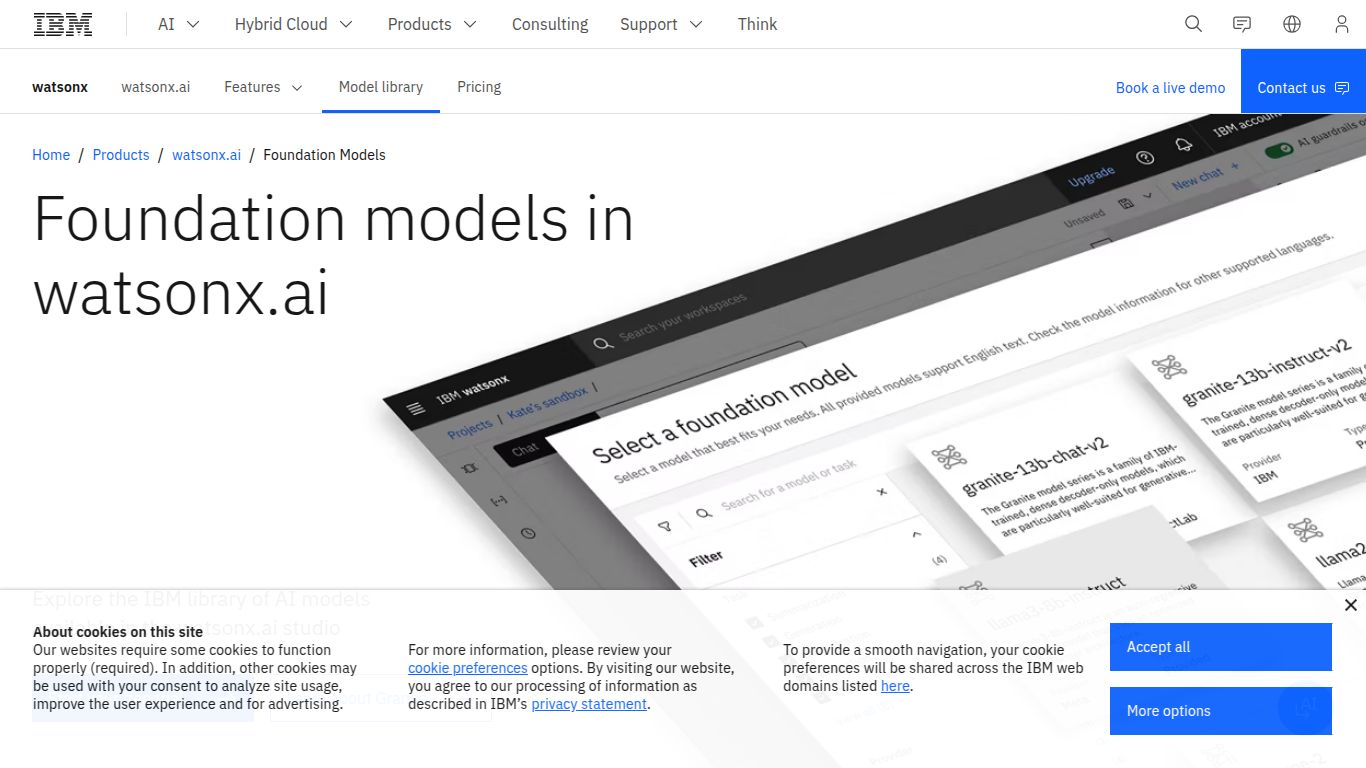
In the rapidly evolving landscape of artificial intelligence, enterprises need a platform that is not only powerful but also trustworthy, scalable, and governed. Enter the IBM watsonx.ai Foundation Model Library, a cornerstone of IBM’s comprehensive AI and data platform. Developed by the tech giant IBM, this library isn’t just a collection of models; it’s a curated, enterprise-ready studio designed to help businesses accelerate the adoption of generative AI with confidence. It provides access to a range of state-of-the-art foundation models from IBM and the open-source community, all within a secure and integrated environment.
Core Capabilities: A Focus on Language and Code
While the broader field of AI encompasses a vast range of modalities, the IBM watsonx.ai Foundation Model Library is expertly honed for text-centric and data-driven tasks. It empowers developers and data scientists to build sophisticated applications without starting from scratch. Key capabilities include:
- Text Generation: Effortlessly create high-quality content, from marketing copy and emails to reports and creative stories.
- Summarization: Condense long documents, articles, or conversations into concise and accurate summaries, saving valuable time.
- Question-Answering: Build intelligent chatbots and virtual assistants that can understand and answer complex queries based on provided documents.
- Code Generation: Accelerate software development by generating code snippets in various programming languages based on natural language descriptions.
- Data Extraction & Classification: Automatically extract structured information from unstructured text (like names, dates, or sentiment) and classify documents into predefined categories.
Distinctive Features of IBM watsonx.ai
What makes the watsonx.ai library stand out is its unwavering focus on enterprise needs. It’s built with features that address the real-world challenges of deploying AI in a corporate setting.
- Curated and Vetted Models: IBM provides access to its own family of models (the Granite series) as well as popular open-source models like Llama 2. Each model is vetted for performance and suitability for business use.
- Data Privacy and Governance: A major differentiator. With watsonx.ai, your data is your data. It is not used to train the base models, ensuring your proprietary information remains secure and confidential.
- Prompt Tuning: Easily and efficiently adapt foundation models for your specific tasks using your own labeled data. This allows for high levels of customization without the massive cost of full-model retraining.
- Integrated Ecosystem: The library is part of the larger watsonx platform, which includes watsonx.data (a fit-for-purpose data store) and watsonx.governance (a toolkit for directing, managing, and monitoring AI activities). This creates a seamless end-to-end workflow.
- Hybrid Cloud Flexibility: Deploy your AI workloads wherever your data resides—on-premises or across any cloud environment.
Pricing Structure: Plans for Every Stage
IBM offers a flexible pricing model designed to accommodate users from experimentation to full-scale production. While specific costs depend on usage and model choice, the structure is generally broken down into the following tiers:
- Lite Plan: Often includes a free tier with a limited number of “Resource Units” per month, perfect for individual developers, students, or anyone looking to experiment with the platform’s capabilities.
- Pay-As-You-Go: A flexible plan where you only pay for what you use. Pricing is typically based on metrics like the number of tokens processed or Resource Unit hours consumed. This is ideal for startups and teams with variable workloads.
- Subscription / Enterprise: For large-scale deployments, IBM offers subscription plans with committed-use discounts, dedicated support, and advanced security features. This tier is designed for enterprises that require predictable costs and robust governance.
Ideal User Profile: Who Should Use It?
The IBM watsonx.ai Foundation Model Library is tailored for professionals who are serious about building and deploying AI solutions within a business context. The primary users include:
- Data Scientists: Who need to experiment with and fine-tune various foundation models for specific analytical tasks.
- AI/ML Engineers: Responsible for building, deploying, and scaling AI-powered applications in production environments.
- Enterprise Developers: Who want to integrate generative AI capabilities into new or existing business applications through APIs.
- Business Analysts: Who can leverage the platform’s more accessible tools (like the Prompt Lab) to prototype solutions and extract insights without deep coding knowledge.
- Chief AI/Data Officers: Who are tasked with implementing a trustworthy and governed AI strategy across the organization.
Alternatives and Competitive Landscape
IBM watsonx.ai operates in a competitive space alongside other major cloud providers offering similar model libraries. Here’s a quick comparison:
- Google Cloud Vertex AI Model Garden: A very direct competitor, offering a wide selection of Google’s own models (like Gemini) and third-party models. It is deeply integrated with the Google Cloud Platform ecosystem.
- Amazon Bedrock: Amazon’s solution for accessing a variety of foundation models (from AI21 Labs, Anthropic, Cohere, and Amazon’s Titan) through a single API. Its strength lies in its integration with AWS services.
- Azure OpenAI Service: The go-to choice for businesses heavily invested in the Microsoft ecosystem. It provides enterprise-grade access to OpenAI’s powerful models (like GPT-4) with Azure’s security and compliance features.
- Hugging Face: While more of an open-source community and hub, its Enterprise Hub offers private model hosting, security, and support, making it an alternative for teams that prefer a more open, community-driven approach.
In conclusion, the IBM watsonx.ai Foundation Model Library carves out its niche by focusing squarely on enterprise trust, data governance, and hybrid cloud flexibility, making it a compelling choice for established businesses, especially those in regulated industries.