Kaggle Models: Your Gateway to the World of Pre-Trained AI
Welcome to the powerhouse of machine learning! Kaggle Models, developed and maintained by Google, is not just another AI tool; it’s a comprehensive, open-source library and community hub designed to accelerate your AI and data science projects. Think of it as a massive, shared brain for the global data science community, where you can find, explore, and deploy thousands of state-of-the-art, pre-trained models for virtually any task you can imagine. Instead of starting from scratch, Kaggle Models empowers you to stand on the shoulders of giants, leveraging cutting-edge models directly within the renowned Kaggle ecosystem.
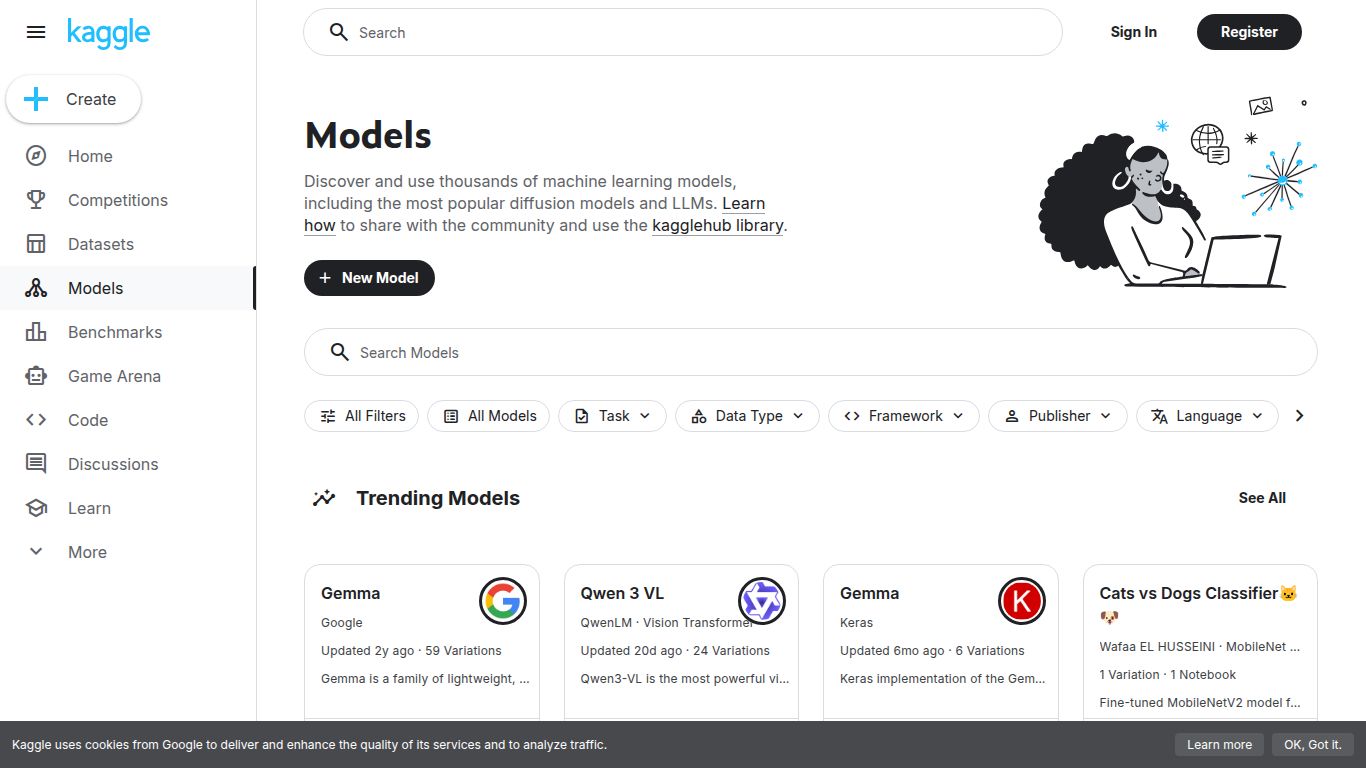
Core Capabilities: A Universe of Models at Your Fingertips
Kaggle Models itself is a discovery platform, but the models it hosts cover a vast spectrum of AI capabilities. You can find pre-trained solutions for:
- Text Generation & NLP: Access powerful Large Language Models (LLMs) like Google’s Gemma, Llama, and Mistral for tasks ranging from content creation and chatbots to sentiment analysis and code generation.
- Image Generation & Computer Vision: Discover and utilize models like Stable Diffusion for stunning text-to-image creation, or find robust models for object detection, image classification, and segmentation.
- Audio Processing: Find models capable of speech-to-text transcription, music generation, and audio classification.
- Tabular Data & Forecasting: Leverage sophisticated models for predictive analytics, time-series forecasting, and classification tasks on structured data.
- And Much More: The library is constantly expanding with models for video intelligence, reinforcement learning, and other specialized domains.
Distinctive Features: Why Kaggle Models Stands Out
Kaggle Models is more than just a repository; it’s a fully integrated workspace with unique advantages.
- Seamless Integration with Kaggle Notebooks: This is the killer feature. You can load any model from the hub directly into a free Kaggle Notebook with a few lines of code, giving you instant access to powerful GPU and TPU hardware for experimentation and fine-tuning.
- Multiple Framework Support: Whether you’re a fan of TensorFlow, PyTorch, or JAX, Kaggle Models has you covered. The platform supports a wide array of popular machine learning frameworks.
- Model Variations & Collections: Easily find different versions of a model (e.g., a lightweight 2B parameter version vs. a powerful 7B one) or curated collections of models for specific tasks, saving you valuable research time.
- Community-Driven with Rich Documentation: Each model often comes with detailed documentation, usage examples in notebooks, and a community discussion board, making it easy to get started and troubleshoot.
Pricing: Powerfully and Unbelievably Free
Here’s the best part. Accessing and using the models on the Kaggle Models platform is completely free.
- Free Plan: $0/month. This includes access to the entire model library and generous weekly quotas of free computing resources, including GPUs and TPUs, within Kaggle Notebooks. This makes it an incredibly accessible platform for learning, experimentation, and even building production-ready applications without any upfront cost.
Ideal User Profile: Who Is Kaggle Models For?
Kaggle Models caters to a wide range of individuals passionate about data and AI:
- Data Scientists: For rapidly prototyping solutions and benchmarking different models.
- Machine Learning Engineers: For finding and fine-tuning foundation models for deployment in applications.
- AI Researchers & Academics: For accessing and building upon state-of-the-art models for novel research.
- Students & AI Learners: An invaluable free resource for hands-on learning with real-world, powerful models.
- Software Developers: For easily integrating advanced AI capabilities like text or image generation into their software.
- AI Hobbyists & Enthusiasts: For exploring the cutting edge of AI without the need for expensive hardware.
Alternatives & Competitive Landscape
While Kaggle Models is a top-tier platform, it’s helpful to know its peers.
- Hugging Face Hub: The most direct and largest competitor. Hugging Face is an enormous ecosystem with an even larger collection of models, datasets, and tools. Its `transformers` library is the industry standard. While Hugging Face is broader, Kaggle Models’ key advantage is its deep, seamless integration with the Kaggle Notebooks, datasets, and competition environment.
- TensorFlow Hub: A great resource specifically for models saved in the TensorFlow format. It’s well-organized but less diverse in terms of frameworks compared to Kaggle or Hugging Face.
- PyTorch Hub: Similar to TensorFlow Hub, this is the official repository for key PyTorch models, offering a streamlined way to load models directly from PyTorch.
- Cloud AI Platforms (e.g., Vertex AI Model Garden): Services from Google Cloud, AWS, and Azure offer curated model gardens, but they are often tied to their specific cloud ecosystem and are geared more towards enterprise-level MLOps and deployment.