Civitai
Community hub for sharing generative image/video models and LoRAs (Stable Diffusion, Flux, etc.).
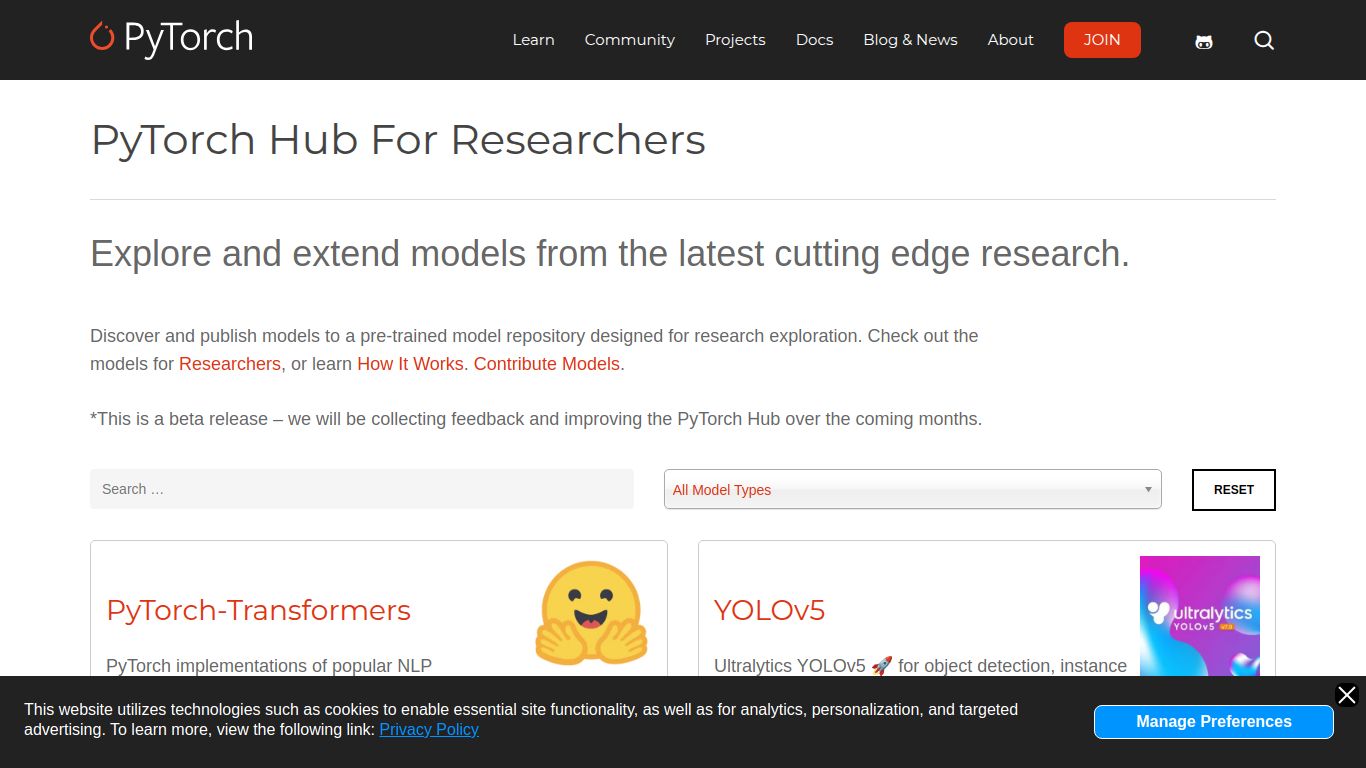
Official PyTorch repository of pretrained models across vision, NLP, and audio for easy loading.
PyTorch Hub is a central repository of pre-trained machine learning models designed to streamline the research and development workflow for AI practitioners. Developed and maintained by Meta AI (formerly Facebook AI), it is an integral part of the popular open-source PyTorch framework. Its core mission is brilliantly simple: to provide a straightforward API for discovering, loading, and using state-of-the-art models with just a few lines of code. Instead of manually downloading models and managing dependencies, PyTorch Hub lets you pull cutting-edge models directly from GitHub repositories, accelerating your journey from idea to implementation.
While PyTorch Hub itself is a facilitator, the models it hosts unlock a vast spectrum of AI capabilities. It serves as a gateway to powerful solutions across numerous domains, including:
PyTorch Hub is more than just a model collection; it’s a productivity powerhouse packed with features designed for efficiency and reliability.
torch.hub.load() function, a single, intuitive command to fetch and instantiate a model.One of the most compelling aspects of PyTorch Hub is its accessibility. As part of the open-source PyTorch project, PyTorch Hub is completely free for everyone. There are no pricing plans, subscription tiers, or usage limits. Whether you are a student, a researcher at a major institution, or a developer at a startup, you can leverage its full power without any cost, fostering innovation and democratizing access to powerful AI technology.
PyTorch Hub caters to a wide range of users within the AI and software development communities:
While PyTorch Hub is a fantastic resource, it’s helpful to know its place in the broader ecosystem.
Often seen as the most comprehensive alternative, the Hugging Face Hub is a massive platform for models, datasets, and demos (Spaces). It supports multiple frameworks (including PyTorch and TensorFlow) and has a very strong community focus, especially for NLP. Comparison: Hugging Face is more of an all-in-one community platform with extensive tools, while PyTorch Hub is a more lightweight, tightly integrated component of the PyTorch framework itself.
This is the direct counterpart to PyTorch Hub for the TensorFlow and Keras ecosystem. It serves the same core purpose: providing easy access to pre-trained models. Comparison: The primary deciding factor between PyTorch Hub and TensorFlow Hub is your choice of deep learning framework. They are functionally equivalent for their respective ecosystems.
NVIDIA’s NGC catalog offers a collection of GPU-optimized models, containers, and SDKs. It’s heavily focused on performance and deployment on NVIDIA hardware. Comparison: NGC is geared more towards enterprise-grade, performance-critical deployments, whereas PyTorch Hub is more focused on research, flexibility, and general-purpose development.