Klaviyo — AI for Email
AI-assisted copy and predictions for ecommerce segmentation, timing, and revenue lift.
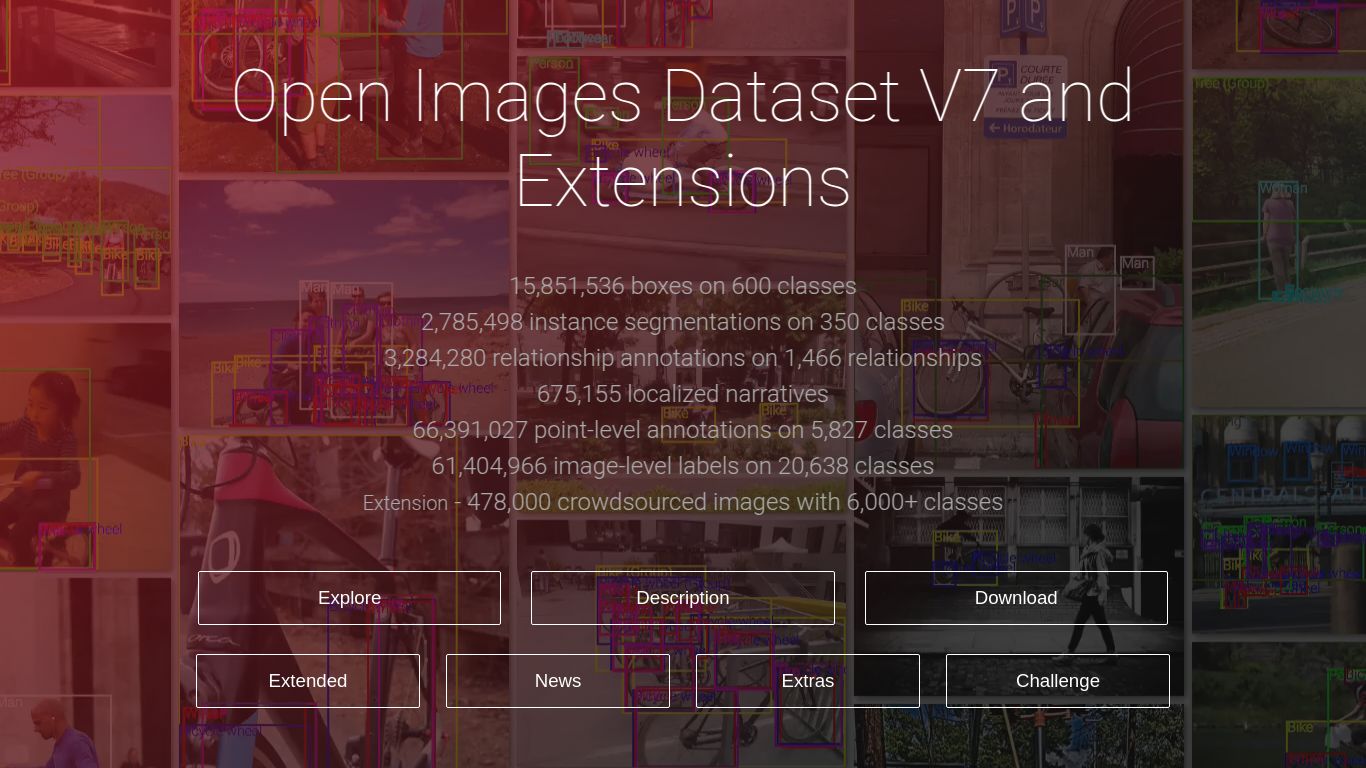
Large-scale annotated image dataset with boxes, masks, relationships, and more.
Welcome to a comprehensive look at the Open Images Dataset, a true powerhouse resource for anyone working in the field of computer vision and artificial intelligence. Developed and maintained by Google AI, this isn’t a typical AI tool that performs a function; instead, it’s the foundational fuel that powers the creation and training of cutting-edge AI models. Open Images is a colossal, publicly available dataset of images annotated with an incredible level of detail, designed to accelerate research and development in image recognition, object detection, and beyond.
It’s crucial to understand that Open Images Dataset is not a generative tool—it doesn’t create images, text, or videos. Rather, it provides the high-quality, labeled data necessary to train models that can understand and interpret visual information. Its capabilities lie in the richness of its data.
What makes the Open Images Dataset a go-to resource for the AI community? It boils down to a few standout features that set it apart.
Unprecedented Scale and Diversity: With millions of images and tens of millions of annotations, it is one of the largest and most varied datasets of its kind, minimizing model bias and improving generalization.
Hierarchical Class Structure: It features a massive hierarchy of over 20,000 object classes, allowing for the training of models that can understand nuanced differences between objects (e.g., distinguishing between a “Sofa” and a “Loveseat”).
Human-Verified Annotations: Unlike datasets scraped from the web with noisy labels, the annotations in Open Images have been meticulously created and verified by human annotators, ensuring high quality and accuracy for training robust models.
Permissive Licensing: The images are listed under a Creative Commons (CC BY 4.0) license, making it widely accessible for both academic research and commercial applications.
The Open Images Dataset is a testament to Google’s commitment to advancing AI research and is available completely free of charge. There are no subscription plans, tiers, or hidden fees for accessing the data.
This dataset is an invaluable asset for a wide range of professionals and enthusiasts in the AI and tech space. If you fall into one of these categories, Open Images is for you:
While Open Images is a top-tier dataset, the computer vision landscape has other notable players. Here’s how it stacks up against them.
COCO is another highly popular dataset, famous for its high-quality segmentation masks and contextual information. Comparison: COCO is smaller than Open Images but is often considered the gold standard for benchmarking object detection and segmentation models due to its meticulous annotations. Open Images offers a far greater number of object classes and image diversity, making it better for training models intended for a wider range of real-world scenarios.
ImageNet is the legendary dataset that arguably kicked off the deep learning revolution. Comparison: ImageNet is massive but is primarily designed for image classification (assigning a single label to an entire image). Open Images provides much richer, multi-faceted annotations per image, including bounding boxes and segmentation masks for multiple objects, making it superior for tasks beyond simple classification.
LAION-5B is an enormous dataset scraped from the web, containing 5 billion image-text pairs. Comparison: LAION’s strength is its sheer, unparalleled scale. However, its labels are “noisy” as they are derived from web alt-text, not human verification. Open Images offers significantly higher-quality, structured, and verified annotations, making it a more reliable choice for training precise and dependable models.