OpenAI API: The Ultimate Gateway to Advanced AI Integration
Welcome to the engine room of the modern AI revolution. The OpenAI API isn’t just a tool; it’s a powerful key that unlocks the groundbreaking capabilities of the world’s most advanced artificial intelligence models. Developed by OpenAI, the pioneering research and deployment company behind phenomena like ChatGPT, DALL-E, and Sora, this Application Programming Interface (API) allows developers, creators, and businesses to seamlessly integrate state-of-the-art AI into their own applications, websites, and workflows. Forget building complex models from scratch; the OpenAI API provides direct access to a suite of pre-trained, cutting-edge models ready to tackle tasks ranging from natural language understanding to hyper-realistic image generation.
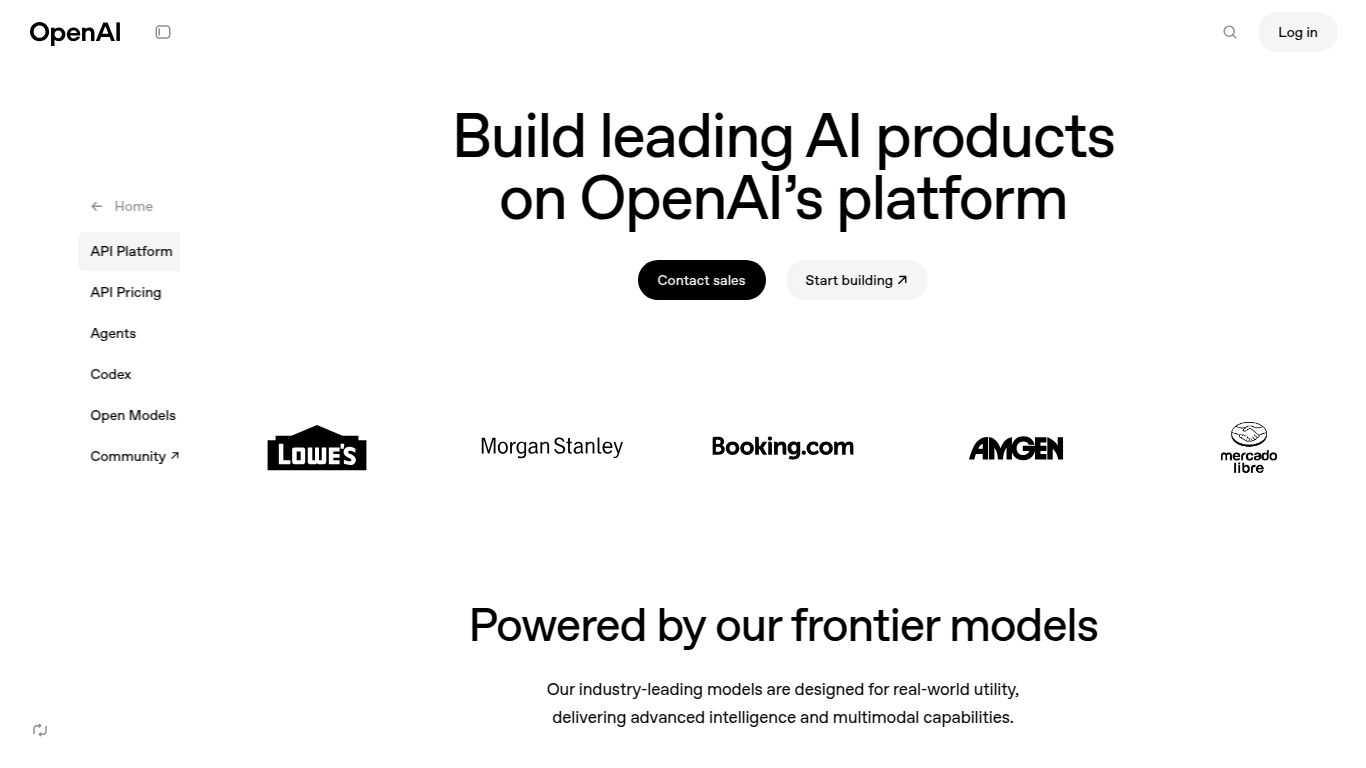
Unleashing a Spectrum of AI Capabilities
The OpenAI API is a multi-talented powerhouse, offering a diverse range of functionalities through its specialized models. It’s a comprehensive toolkit designed to be the backbone of any intelligent application.
- Advanced Text Generation & Understanding: At its core are the GPT (Generative Pre-trained Transformer) models, including the flagship GPT-4o and the lightning-fast GPT-3.5 Turbo. These models excel at content creation, summarization, translation, code generation, sentiment analysis, and complex conversational AI. They can write emails, debug code, create marketing copy, or act as a sophisticated chatbot.
- Stunning Image Generation: With the DALL-E 3 model, the API can transform simple text prompts into breathtakingly detailed and creative images. Whether you need photorealistic product mockups, artistic illustrations, or unique graphics for your content, DALL-E brings your visual ideas to life in seconds.
- Crystal-Clear Audio Processing: The API includes the Whisper model for highly accurate speech-to-text transcription across multiple languages, making it perfect for transcribing meetings, podcasts, or voice notes. Conversely, the Text-to-Speech (TTS) models can convert written text into natural-sounding human speech in various voices, ideal for audiobooks, accessibility tools, and voice assistants.
- Semantic Search & Data Analysis: Using Embeddings, the API can convert text into numerical representations, enabling sophisticated semantic search, clustering, and recommendation systems that understand context and nuance far better than traditional keyword-based methods.
Core Features That Empower Innovation
What makes the OpenAI API a top choice for developers and businesses worldwide? It’s a combination of raw power and thoughtful design.
- State-of-the-Art Performance: Gain access to the latest and most capable models on the market as soon as they are optimized for API use, ensuring your application stays on the cutting edge.
- Scalability and Reliability: Built on a robust infrastructure, the API is designed to handle everything from small personal projects to enterprise-level applications with millions of users, ensuring high availability and consistent performance.
- Seamless Integration: With comprehensive documentation, official libraries for popular languages like Python and Node.js, and a straightforward REST API, integrating OpenAI’s power into your project is remarkably simple and fast.
- Fine-Tuning & Customization: For specialized tasks, the API allows you to fine-tune base models on your own data, creating a customized AI that understands your specific industry jargon, style, or use case.
- Built-in Safety Measures: OpenAI provides free moderation endpoints and other safety tools to help developers build responsible AI applications and filter out undesirable content, promoting a safer digital environment.
Flexible Pricing for Every Scale
OpenAI employs a transparent, pay-as-you-go pricing model, making it accessible for projects of all sizes. You only pay for what you use, with no hefty upfront commitments or subscriptions for the API itself.
- Language Models (GPT-4o, etc.): Pricing is calculated based on “tokens,” which are pieces of words. You are charged a specific rate per 1,000 tokens for both the input (your prompt) and the output (the AI’s response). Newer, more efficient models often come with significantly lower costs.
- Image Models (DALL-E 3): Pricing is on a per-image basis, with costs varying depending on the requested resolution and quality (Standard or HD).
- Audio Models (Whisper, TTS): Whisper is typically priced per minute of audio transcribed, while TTS models are priced per 1,000 characters of text converted to speech.
Note: For the most current and detailed pricing information, it is always best to consult the official OpenAI pricing page.
Who is the OpenAI API For?
The versatility of the OpenAI API makes it an indispensable tool for a wide range of professionals and organizations:
- Software Developers & Engineers: The primary audience, building AI-powered features, chatbots, data analysis tools, and entirely new applications.
- Startups & Entrepreneurs: Leveraging the API to rapidly prototype and launch innovative products without the massive R&D cost of building foundational models.
- Content Creators & Marketers: Automating the creation of blog posts, social media updates, ad copy, and SEO content at scale.
- Data Scientists & Researchers: Using the models for complex data analysis, sentiment tracking, and academic research in natural language processing.
- Enterprises: Integrating AI into customer support systems, internal knowledge bases, and business intelligence workflows to boost efficiency and productivity.
Alternatives & Competitive Landscape
While OpenAI is a dominant force, the AI API space is vibrant and competitive. Here’s how it stacks up against other major players:
- Google Gemini (Vertex AI): A formidable competitor with deep integration into the Google Cloud ecosystem. Gemini is known for its strong multimodal capabilities and is a go-to choice for businesses already invested in Google’s infrastructure.
- Anthropic Claude: Claude’s APIs are a strong alternative, often praised for their large context windows (handling massive amounts of text), sophisticated reasoning, and a strong emphasis on AI safety and constitutional principles.
- Mistral AI: A powerful player from Europe, offering both proprietary high-performance models and open-source models. Mistral is often favored for its cost-effectiveness and the flexibility provided by its open-weight models, which can be self-hosted.
In summary, the OpenAI API remains a top-tier choice for those seeking best-in-class model performance, ease of use, and a robust, well-documented ecosystem. It is the definitive toolkit for anyone serious about building the next generation of intelligent applications.