Glean Assistant & Chat
Enterprise-grade chat + search across code, docs, and apps; cites sources and respects perms.
Low-code builder to compose agentic and RAG workflows with broad LLM and tool support.
Product Managers & UI/UX Designers: To build functional AI prototypes and proof-of-concepts to test ideas without needing to write a single line of code.
Startups & Innovators: To quickly build and iterate on AI-powered MVPs (Minimum Viable Products) and get to market faster.
Students & Hobbyists: As an exceptional educational tool for understanding the architecture of LLM applications in a hands-on, interactive way.
FlowiseAI is the most direct competitor to Langflow. Both are open-source, visual builders for LangChain. The choice often comes down to personal preference in user interface, the specific set of available components, and the activity level of their respective communities. Langflow is often praised for its polished UI and rapid feature development.
Dify is a more comprehensive LLMOps (Large Language Model Operations) platform that includes visual app building as one of its features. While Langflow focuses purely on the orchestration layer, Dify provides a more all-in-one solution with backend-as-a-service features, including data management and simple API deployment. Langflow offers deeper integration and granularity with the LangChain ecosystem.
The classic trade-off. Writing code directly in Python with the LangChain library offers maximum flexibility and control. Langflow, on the other hand, offers unparalleled speed for prototyping, visualization, and ease of use, especially for those less comfortable with coding. Many developers use Langflow to design the initial logic and then export the code for further customization.AI & LLM Developers: To rapidly prototype, visualize, and debug complex LangChain applications before committing to production code.
Prompt Engineers: To design, test, and manage intricate prompt chains and agentic workflows in a structured, visual environment.
Product Managers & UI/UX Designers: To build functional AI prototypes and proof-of-concepts to test ideas without needing to write a single line of code.
Startups & Innovators: To quickly build and iterate on AI-powered MVPs (Minimum Viable Products) and get to market faster.
Students & Hobbyists: As an exceptional educational tool for understanding the architecture of LLM applications in a hands-on, interactive way.
FlowiseAI is the most direct competitor to Langflow. Both are open-source, visual builders for LangChain. The choice often comes down to personal preference in user interface, the specific set of available components, and the activity level of their respective communities. Langflow is often praised for its polished UI and rapid feature development.
Dify is a more comprehensive LLMOps (Large Language Model Operations) platform that includes visual app building as one of its features. While Langflow focuses purely on the orchestration layer, Dify provides a more all-in-one solution with backend-as-a-service features, including data management and simple API deployment. Langflow offers deeper integration and granularity with the LangChain ecosystem.
The classic trade-off. Writing code directly in Python with the LangChain library offers maximum flexibility and control. Langflow, on the other hand, offers unparalleled speed for prototyping, visualization, and ease of use, especially for those less comfortable with coding. Many developers use Langflow to design the initial logic and then export the code for further customization.
Prompt Engineers: To design, test, and manage intricate prompt chains and agentic workflows in a structured, visual environment.
Product Managers & UI/UX Designers: To build functional AI prototypes and proof-of-concepts to test ideas without needing to write a single line of code.
Startups & Innovators: To quickly build and iterate on AI-powered MVPs (Minimum Viable Products) and get to market faster.
Students & Hobbyists: As an exceptional educational tool for understanding the architecture of LLM applications in a hands-on, interactive way.
FlowiseAI is the most direct competitor to Langflow. Both are open-source, visual builders for LangChain. The choice often comes down to personal preference in user interface, the specific set of available components, and the activity level of their respective communities. Langflow is often praised for its polished UI and rapid feature development.
Dify is a more comprehensive LLMOps (Large Language Model Operations) platform that includes visual app building as one of its features. While Langflow focuses purely on the orchestration layer, Dify provides a more all-in-one solution with backend-as-a-service features, including data management and simple API deployment. Langflow offers deeper integration and granularity with the LangChain ecosystem.
The classic trade-off. Writing code directly in Python with the LangChain library offers maximum flexibility and control. Langflow, on the other hand, offers unparalleled speed for prototyping, visualization, and ease of use, especially for those less comfortable with coding. Many developers use Langflow to design the initial logic and then export the code for further customization.
Prompt Engineers: To design, test, and manage intricate prompt chains and agentic workflows in a structured, visual environment.
Product Managers & UI/UX Designers: To build functional AI prototypes and proof-of-concepts to test ideas without needing to write a single line of code.
Startups & Innovators: To quickly build and iterate on AI-powered MVPs (Minimum Viable Products) and get to market faster.
Students & Hobbyists: As an exceptional educational tool for understanding the architecture of LLM applications in a hands-on, interactive way.
FlowiseAI is the most direct competitor to Langflow. Both are open-source, visual builders for LangChain. The choice often comes down to personal preference in user interface, the specific set of available components, and the activity level of their respective communities. Langflow is often praised for its polished UI and rapid feature development.
Dify is a more comprehensive LLMOps (Large Language Model Operations) platform that includes visual app building as one of its features. While Langflow focuses purely on the orchestration layer, Dify provides a more all-in-one solution with backend-as-a-service features, including data management and simple API deployment. Langflow offers deeper integration and granularity with the LangChain ecosystem.
The classic trade-off. Writing code directly in Python with the LangChain library offers maximum flexibility and control. Langflow, on the other hand, offers unparalleled speed for prototyping, visualization, and ease of use, especially for those less comfortable with coding. Many developers use Langflow to design the initial logic and then export the code for further customization.Interactive Chat Interface: Test your application immediately within the Langflow UI. The built-in chat window lets you interact with your creation and see how it performs in real-time.
Exportable and Shareable Flows: Once you’re happy with your design, you can export it as a JSON file or even generate the equivalent Python code. This makes it easy to share your work or deploy it in a production environment.
Component Store & Extensibility: Discover and use custom components created by the community from the Langflow Store, or build your own to extend the platform’s functionality for your unique needs.
Langflow offers flexible pricing options to suit different needs, from individual hobbyists to large enterprises.
Price: Free. For developers and teams who want complete control, you can host Langflow on your own infrastructure at no cost. You are only responsible for your own hosting and API usage fees.
Price: Free. Perfect for individuals, students, and anyone looking to explore the platform. This tier provides a generous amount of credits and features to get you started building and experimenting without any financial commitment.
Price: Subscription-based. Aimed at professionals, startups, and small teams, the Pro plan offers significantly more usage credits, access to premium features, more projects, and priority support to help you build and scale your applications.
Price: Custom. Designed for large organizations with specific requirements for security, scalability, and support. This plan includes features like SSO, dedicated infrastructure, custom integrations, and white-glove support.
Prompt Engineers: To design, test, and manage intricate prompt chains and agentic workflows in a structured, visual environment.
Product Managers & UI/UX Designers: To build functional AI prototypes and proof-of-concepts to test ideas without needing to write a single line of code.
Startups & Innovators: To quickly build and iterate on AI-powered MVPs (Minimum Viable Products) and get to market faster.
Students & Hobbyists: As an exceptional educational tool for understanding the architecture of LLM applications in a hands-on, interactive way.
FlowiseAI is the most direct competitor to Langflow. Both are open-source, visual builders for LangChain. The choice often comes down to personal preference in user interface, the specific set of available components, and the activity level of their respective communities. Langflow is often praised for its polished UI and rapid feature development.
Dify is a more comprehensive LLMOps (Large Language Model Operations) platform that includes visual app building as one of its features. While Langflow focuses purely on the orchestration layer, Dify provides a more all-in-one solution with backend-as-a-service features, including data management and simple API deployment. Langflow offers deeper integration and granularity with the LangChain ecosystem.
The classic trade-off. Writing code directly in Python with the LangChain library offers maximum flexibility and control. Langflow, on the other hand, offers unparalleled speed for prototyping, visualization, and ease of use, especially for those less comfortable with coding. Many developers use Langflow to design the initial logic and then export the code for further customization.Real-time Validation & Debugging: See your flow come to life as you build it. The interface provides instant feedback and helps you identify and fix issues on the fly, dramatically speeding up the development cycle.
Interactive Chat Interface: Test your application immediately within the Langflow UI. The built-in chat window lets you interact with your creation and see how it performs in real-time.
Exportable and Shareable Flows: Once you’re happy with your design, you can export it as a JSON file or even generate the equivalent Python code. This makes it easy to share your work or deploy it in a production environment.
Component Store & Extensibility: Discover and use custom components created by the community from the Langflow Store, or build your own to extend the platform’s functionality for your unique needs.
Langflow offers flexible pricing options to suit different needs, from individual hobbyists to large enterprises.
Price: Free. For developers and teams who want complete control, you can host Langflow on your own infrastructure at no cost. You are only responsible for your own hosting and API usage fees.
Price: Free. Perfect for individuals, students, and anyone looking to explore the platform. This tier provides a generous amount of credits and features to get you started building and experimenting without any financial commitment.
Price: Subscription-based. Aimed at professionals, startups, and small teams, the Pro plan offers significantly more usage credits, access to premium features, more projects, and priority support to help you build and scale your applications.
Price: Custom. Designed for large organizations with specific requirements for security, scalability, and support. This plan includes features like SSO, dedicated infrastructure, custom integrations, and white-glove support.
Prompt Engineers: To design, test, and manage intricate prompt chains and agentic workflows in a structured, visual environment.
Product Managers & UI/UX Designers: To build functional AI prototypes and proof-of-concepts to test ideas without needing to write a single line of code.
Startups & Innovators: To quickly build and iterate on AI-powered MVPs (Minimum Viable Products) and get to market faster.
Students & Hobbyists: As an exceptional educational tool for understanding the architecture of LLM applications in a hands-on, interactive way.
FlowiseAI is the most direct competitor to Langflow. Both are open-source, visual builders for LangChain. The choice often comes down to personal preference in user interface, the specific set of available components, and the activity level of their respective communities. Langflow is often praised for its polished UI and rapid feature development.
Dify is a more comprehensive LLMOps (Large Language Model Operations) platform that includes visual app building as one of its features. While Langflow focuses purely on the orchestration layer, Dify provides a more all-in-one solution with backend-as-a-service features, including data management and simple API deployment. Langflow offers deeper integration and granularity with the LangChain ecosystem.
The classic trade-off. Writing code directly in Python with the LangChain library offers maximum flexibility and control. Langflow, on the other hand, offers unparalleled speed for prototyping, visualization, and ease of use, especially for those less comfortable with coding. Many developers use Langflow to design the initial logic and then export the code for further customization.Rich Component Library: Langflow comes packed with a comprehensive set of pre-built components representing everything in the LangChain ecosystem—LLMs, prompt templates, memory modules, data loaders, agents, and tools.
Real-time Validation & Debugging: See your flow come to life as you build it. The interface provides instant feedback and helps you identify and fix issues on the fly, dramatically speeding up the development cycle.
Interactive Chat Interface: Test your application immediately within the Langflow UI. The built-in chat window lets you interact with your creation and see how it performs in real-time.
Exportable and Shareable Flows: Once you’re happy with your design, you can export it as a JSON file or even generate the equivalent Python code. This makes it easy to share your work or deploy it in a production environment.
Component Store & Extensibility: Discover and use custom components created by the community from the Langflow Store, or build your own to extend the platform’s functionality for your unique needs.
Langflow offers flexible pricing options to suit different needs, from individual hobbyists to large enterprises.
Price: Free. For developers and teams who want complete control, you can host Langflow on your own infrastructure at no cost. You are only responsible for your own hosting and API usage fees.
Price: Free. Perfect for individuals, students, and anyone looking to explore the platform. This tier provides a generous amount of credits and features to get you started building and experimenting without any financial commitment.
Price: Subscription-based. Aimed at professionals, startups, and small teams, the Pro plan offers significantly more usage credits, access to premium features, more projects, and priority support to help you build and scale your applications.
Price: Custom. Designed for large organizations with specific requirements for security, scalability, and support. This plan includes features like SSO, dedicated infrastructure, custom integrations, and white-glove support.
Prompt Engineers: To design, test, and manage intricate prompt chains and agentic workflows in a structured, visual environment.
Product Managers & UI/UX Designers: To build functional AI prototypes and proof-of-concepts to test ideas without needing to write a single line of code.
Startups & Innovators: To quickly build and iterate on AI-powered MVPs (Minimum Viable Products) and get to market faster.
Students & Hobbyists: As an exceptional educational tool for understanding the architecture of LLM applications in a hands-on, interactive way.
FlowiseAI is the most direct competitor to Langflow. Both are open-source, visual builders for LangChain. The choice often comes down to personal preference in user interface, the specific set of available components, and the activity level of their respective communities. Langflow is often praised for its polished UI and rapid feature development.
Dify is a more comprehensive LLMOps (Large Language Model Operations) platform that includes visual app building as one of its features. While Langflow focuses purely on the orchestration layer, Dify provides a more all-in-one solution with backend-as-a-service features, including data management and simple API deployment. Langflow offers deeper integration and granularity with the LangChain ecosystem.
The classic trade-off. Writing code directly in Python with the LangChain library offers maximum flexibility and control. Langflow, on the other hand, offers unparalleled speed for prototyping, visualization, and ease of use, especially for those less comfortable with coding. Many developers use Langflow to design the initial logic and then export the code for further customization.Intuitive Drag-and-Drop Interface: Forget lines and lines of code. Visually construct your AI logic by dragging components onto a canvas and connecting them. It’s an incredibly intuitive and satisfying way to build.
Rich Component Library: Langflow comes packed with a comprehensive set of pre-built components representing everything in the LangChain ecosystem—LLMs, prompt templates, memory modules, data loaders, agents, and tools.
Real-time Validation & Debugging: See your flow come to life as you build it. The interface provides instant feedback and helps you identify and fix issues on the fly, dramatically speeding up the development cycle.
Interactive Chat Interface: Test your application immediately within the Langflow UI. The built-in chat window lets you interact with your creation and see how it performs in real-time.
Exportable and Shareable Flows: Once you’re happy with your design, you can export it as a JSON file or even generate the equivalent Python code. This makes it easy to share your work or deploy it in a production environment.
Component Store & Extensibility: Discover and use custom components created by the community from the Langflow Store, or build your own to extend the platform’s functionality for your unique needs.
Langflow offers flexible pricing options to suit different needs, from individual hobbyists to large enterprises.
Price: Free. For developers and teams who want complete control, you can host Langflow on your own infrastructure at no cost. You are only responsible for your own hosting and API usage fees.
Price: Free. Perfect for individuals, students, and anyone looking to explore the platform. This tier provides a generous amount of credits and features to get you started building and experimenting without any financial commitment.
Price: Subscription-based. Aimed at professionals, startups, and small teams, the Pro plan offers significantly more usage credits, access to premium features, more projects, and priority support to help you build and scale your applications.
Price: Custom. Designed for large organizations with specific requirements for security, scalability, and support. This plan includes features like SSO, dedicated infrastructure, custom integrations, and white-glove support.
Prompt Engineers: To design, test, and manage intricate prompt chains and agentic workflows in a structured, visual environment.
Product Managers & UI/UX Designers: To build functional AI prototypes and proof-of-concepts to test ideas without needing to write a single line of code.
Startups & Innovators: To quickly build and iterate on AI-powered MVPs (Minimum Viable Products) and get to market faster.
Students & Hobbyists: As an exceptional educational tool for understanding the architecture of LLM applications in a hands-on, interactive way.
FlowiseAI is the most direct competitor to Langflow. Both are open-source, visual builders for LangChain. The choice often comes down to personal preference in user interface, the specific set of available components, and the activity level of their respective communities. Langflow is often praised for its polished UI and rapid feature development.
Dify is a more comprehensive LLMOps (Large Language Model Operations) platform that includes visual app building as one of its features. While Langflow focuses purely on the orchestration layer, Dify provides a more all-in-one solution with backend-as-a-service features, including data management and simple API deployment. Langflow offers deeper integration and granularity with the LangChain ecosystem.
The classic trade-off. Writing code directly in Python with the LangChain library offers maximum flexibility and control. Langflow, on the other hand, offers unparalleled speed for prototyping, visualization, and ease of use, especially for those less comfortable with coding. Many developers use Langflow to design the initial logic and then export the code for further customization.
Rich Component Library: Langflow comes packed with a comprehensive set of pre-built components representing everything in the LangChain ecosystem—LLMs, prompt templates, memory modules, data loaders, agents, and tools.
Real-time Validation & Debugging: See your flow come to life as you build it. The interface provides instant feedback and helps you identify and fix issues on the fly, dramatically speeding up the development cycle.
Interactive Chat Interface: Test your application immediately within the Langflow UI. The built-in chat window lets you interact with your creation and see how it performs in real-time.
Exportable and Shareable Flows: Once you’re happy with your design, you can export it as a JSON file or even generate the equivalent Python code. This makes it easy to share your work or deploy it in a production environment.
Component Store & Extensibility: Discover and use custom components created by the community from the Langflow Store, or build your own to extend the platform’s functionality for your unique needs.
Langflow offers flexible pricing options to suit different needs, from individual hobbyists to large enterprises.
Price: Free. For developers and teams who want complete control, you can host Langflow on your own infrastructure at no cost. You are only responsible for your own hosting and API usage fees.
Price: Free. Perfect for individuals, students, and anyone looking to explore the platform. This tier provides a generous amount of credits and features to get you started building and experimenting without any financial commitment.
Price: Subscription-based. Aimed at professionals, startups, and small teams, the Pro plan offers significantly more usage credits, access to premium features, more projects, and priority support to help you build and scale your applications.
Price: Custom. Designed for large organizations with specific requirements for security, scalability, and support. This plan includes features like SSO, dedicated infrastructure, custom integrations, and white-glove support.
Prompt Engineers: To design, test, and manage intricate prompt chains and agentic workflows in a structured, visual environment.
Product Managers & UI/UX Designers: To build functional AI prototypes and proof-of-concepts to test ideas without needing to write a single line of code.
Startups & Innovators: To quickly build and iterate on AI-powered MVPs (Minimum Viable Products) and get to market faster.
Students & Hobbyists: As an exceptional educational tool for understanding the architecture of LLM applications in a hands-on, interactive way.
FlowiseAI is the most direct competitor to Langflow. Both are open-source, visual builders for LangChain. The choice often comes down to personal preference in user interface, the specific set of available components, and the activity level of their respective communities. Langflow is often praised for its polished UI and rapid feature development.
Dify is a more comprehensive LLMOps (Large Language Model Operations) platform that includes visual app building as one of its features. While Langflow focuses purely on the orchestration layer, Dify provides a more all-in-one solution with backend-as-a-service features, including data management and simple API deployment. Langflow offers deeper integration and granularity with the LangChain ecosystem.
The classic trade-off. Writing code directly in Python with the LangChain library offers maximum flexibility and control. Langflow, on the other hand, offers unparalleled speed for prototyping, visualization, and ease of use, especially for those less comfortable with coding. Many developers use Langflow to design the initial logic and then export the code for further customization.
Rich Component Library: Langflow comes packed with a comprehensive set of pre-built components representing everything in the LangChain ecosystem—LLMs, prompt templates, memory modules, data loaders, agents, and tools.
Real-time Validation & Debugging: See your flow come to life as you build it. The interface provides instant feedback and helps you identify and fix issues on the fly, dramatically speeding up the development cycle.
Interactive Chat Interface: Test your application immediately within the Langflow UI. The built-in chat window lets you interact with your creation and see how it performs in real-time.
Exportable and Shareable Flows: Once you’re happy with your design, you can export it as a JSON file or even generate the equivalent Python code. This makes it easy to share your work or deploy it in a production environment.
Component Store & Extensibility: Discover and use custom components created by the community from the Langflow Store, or build your own to extend the platform’s functionality for your unique needs.
Langflow offers flexible pricing options to suit different needs, from individual hobbyists to large enterprises.
Price: Free. For developers and teams who want complete control, you can host Langflow on your own infrastructure at no cost. You are only responsible for your own hosting and API usage fees.
Price: Free. Perfect for individuals, students, and anyone looking to explore the platform. This tier provides a generous amount of credits and features to get you started building and experimenting without any financial commitment.
Price: Subscription-based. Aimed at professionals, startups, and small teams, the Pro plan offers significantly more usage credits, access to premium features, more projects, and priority support to help you build and scale your applications.
Price: Custom. Designed for large organizations with specific requirements for security, scalability, and support. This plan includes features like SSO, dedicated infrastructure, custom integrations, and white-glove support.
Prompt Engineers: To design, test, and manage intricate prompt chains and agentic workflows in a structured, visual environment.
Product Managers & UI/UX Designers: To build functional AI prototypes and proof-of-concepts to test ideas without needing to write a single line of code.
Startups & Innovators: To quickly build and iterate on AI-powered MVPs (Minimum Viable Products) and get to market faster.
Students & Hobbyists: As an exceptional educational tool for understanding the architecture of LLM applications in a hands-on, interactive way.
FlowiseAI is the most direct competitor to Langflow. Both are open-source, visual builders for LangChain. The choice often comes down to personal preference in user interface, the specific set of available components, and the activity level of their respective communities. Langflow is often praised for its polished UI and rapid feature development.
Dify is a more comprehensive LLMOps (Large Language Model Operations) platform that includes visual app building as one of its features. While Langflow focuses purely on the orchestration layer, Dify provides a more all-in-one solution with backend-as-a-service features, including data management and simple API deployment. Langflow offers deeper integration and granularity with the LangChain ecosystem.
The classic trade-off. Writing code directly in Python with the LangChain library offers maximum flexibility and control. Langflow, on the other hand, offers unparalleled speed for prototyping, visualization, and ease of use, especially for those less comfortable with coding. Many developers use Langflow to design the initial logic and then export the code for further customization.Text & Data Processing: This is Langflow’s home turf. You can build everything from simple chatbots and Q&A systems over documents (RAG) to complex, multi-step agents that perform research, summarize information, and execute tasks based on textual input.
Multi-Modal Orchestration: Langflow allows you to integrate with external APIs for other modalities. You can design a flow where a user’s text prompt is used to generate a new prompt for an image generation model like DALL-E or Midjourney, or send text to a text-to-speech API like ElevenLabs to create audio. The possibilities are defined by the tools you connect.
API Integration & Automation: Seamlessly connect to any third-party API. This means you can build flows that fetch live weather data, search Google, interact with your CRM, or automate workflows across different software platforms, all triggered and managed through your LLM logic.
Rich Component Library: Langflow comes packed with a comprehensive set of pre-built components representing everything in the LangChain ecosystem—LLMs, prompt templates, memory modules, data loaders, agents, and tools.
Real-time Validation & Debugging: See your flow come to life as you build it. The interface provides instant feedback and helps you identify and fix issues on the fly, dramatically speeding up the development cycle.
Interactive Chat Interface: Test your application immediately within the Langflow UI. The built-in chat window lets you interact with your creation and see how it performs in real-time.
Exportable and Shareable Flows: Once you’re happy with your design, you can export it as a JSON file or even generate the equivalent Python code. This makes it easy to share your work or deploy it in a production environment.
Component Store & Extensibility: Discover and use custom components created by the community from the Langflow Store, or build your own to extend the platform’s functionality for your unique needs.
Langflow offers flexible pricing options to suit different needs, from individual hobbyists to large enterprises.
Price: Free. For developers and teams who want complete control, you can host Langflow on your own infrastructure at no cost. You are only responsible for your own hosting and API usage fees.
Price: Free. Perfect for individuals, students, and anyone looking to explore the platform. This tier provides a generous amount of credits and features to get you started building and experimenting without any financial commitment.
Price: Subscription-based. Aimed at professionals, startups, and small teams, the Pro plan offers significantly more usage credits, access to premium features, more projects, and priority support to help you build and scale your applications.
Price: Custom. Designed for large organizations with specific requirements for security, scalability, and support. This plan includes features like SSO, dedicated infrastructure, custom integrations, and white-glove support.
Prompt Engineers: To design, test, and manage intricate prompt chains and agentic workflows in a structured, visual environment.
Product Managers & UI/UX Designers: To build functional AI prototypes and proof-of-concepts to test ideas without needing to write a single line of code.
Startups & Innovators: To quickly build and iterate on AI-powered MVPs (Minimum Viable Products) and get to market faster.
Students & Hobbyists: As an exceptional educational tool for understanding the architecture of LLM applications in a hands-on, interactive way.
FlowiseAI is the most direct competitor to Langflow. Both are open-source, visual builders for LangChain. The choice often comes down to personal preference in user interface, the specific set of available components, and the activity level of their respective communities. Langflow is often praised for its polished UI and rapid feature development.
Dify is a more comprehensive LLMOps (Large Language Model Operations) platform that includes visual app building as one of its features. While Langflow focuses purely on the orchestration layer, Dify provides a more all-in-one solution with backend-as-a-service features, including data management and simple API deployment. Langflow offers deeper integration and granularity with the LangChain ecosystem.
The classic trade-off. Writing code directly in Python with the LangChain library offers maximum flexibility and control. Langflow, on the other hand, offers unparalleled speed for prototyping, visualization, and ease of use, especially for those less comfortable with coding. Many developers use Langflow to design the initial logic and then export the code for further customization.
Multi-Modal Orchestration: Langflow allows you to integrate with external APIs for other modalities. You can design a flow where a user’s text prompt is used to generate a new prompt for an image generation model like DALL-E or Midjourney, or send text to a text-to-speech API like ElevenLabs to create audio. The possibilities are defined by the tools you connect.
API Integration & Automation: Seamlessly connect to any third-party API. This means you can build flows that fetch live weather data, search Google, interact with your CRM, or automate workflows across different software platforms, all triggered and managed through your LLM logic.
Rich Component Library: Langflow comes packed with a comprehensive set of pre-built components representing everything in the LangChain ecosystem—LLMs, prompt templates, memory modules, data loaders, agents, and tools.
Real-time Validation & Debugging: See your flow come to life as you build it. The interface provides instant feedback and helps you identify and fix issues on the fly, dramatically speeding up the development cycle.
Interactive Chat Interface: Test your application immediately within the Langflow UI. The built-in chat window lets you interact with your creation and see how it performs in real-time.
Exportable and Shareable Flows: Once you’re happy with your design, you can export it as a JSON file or even generate the equivalent Python code. This makes it easy to share your work or deploy it in a production environment.
Component Store & Extensibility: Discover and use custom components created by the community from the Langflow Store, or build your own to extend the platform’s functionality for your unique needs.
Langflow offers flexible pricing options to suit different needs, from individual hobbyists to large enterprises.
Price: Free. For developers and teams who want complete control, you can host Langflow on your own infrastructure at no cost. You are only responsible for your own hosting and API usage fees.
Price: Free. Perfect for individuals, students, and anyone looking to explore the platform. This tier provides a generous amount of credits and features to get you started building and experimenting without any financial commitment.
Price: Subscription-based. Aimed at professionals, startups, and small teams, the Pro plan offers significantly more usage credits, access to premium features, more projects, and priority support to help you build and scale your applications.
Price: Custom. Designed for large organizations with specific requirements for security, scalability, and support. This plan includes features like SSO, dedicated infrastructure, custom integrations, and white-glove support.
Prompt Engineers: To design, test, and manage intricate prompt chains and agentic workflows in a structured, visual environment.
Product Managers & UI/UX Designers: To build functional AI prototypes and proof-of-concepts to test ideas without needing to write a single line of code.
Startups & Innovators: To quickly build and iterate on AI-powered MVPs (Minimum Viable Products) and get to market faster.
Students & Hobbyists: As an exceptional educational tool for understanding the architecture of LLM applications in a hands-on, interactive way.
FlowiseAI is the most direct competitor to Langflow. Both are open-source, visual builders for LangChain. The choice often comes down to personal preference in user interface, the specific set of available components, and the activity level of their respective communities. Langflow is often praised for its polished UI and rapid feature development.
Dify is a more comprehensive LLMOps (Large Language Model Operations) platform that includes visual app building as one of its features. While Langflow focuses purely on the orchestration layer, Dify provides a more all-in-one solution with backend-as-a-service features, including data management and simple API deployment. Langflow offers deeper integration and granularity with the LangChain ecosystem.
The classic trade-off. Writing code directly in Python with the LangChain library offers maximum flexibility and control. Langflow, on the other hand, offers unparalleled speed for prototyping, visualization, and ease of use, especially for those less comfortable with coding. Many developers use Langflow to design the initial logic and then export the code for further customization.
Multi-Modal Orchestration: Langflow allows you to integrate with external APIs for other modalities. You can design a flow where a user’s text prompt is used to generate a new prompt for an image generation model like DALL-E or Midjourney, or send text to a text-to-speech API like ElevenLabs to create audio. The possibilities are defined by the tools you connect.
API Integration & Automation: Seamlessly connect to any third-party API. This means you can build flows that fetch live weather data, search Google, interact with your CRM, or automate workflows across different software platforms, all triggered and managed through your LLM logic.
Rich Component Library: Langflow comes packed with a comprehensive set of pre-built components representing everything in the LangChain ecosystem—LLMs, prompt templates, memory modules, data loaders, agents, and tools.
Real-time Validation & Debugging: See your flow come to life as you build it. The interface provides instant feedback and helps you identify and fix issues on the fly, dramatically speeding up the development cycle.
Interactive Chat Interface: Test your application immediately within the Langflow UI. The built-in chat window lets you interact with your creation and see how it performs in real-time.
Exportable and Shareable Flows: Once you’re happy with your design, you can export it as a JSON file or even generate the equivalent Python code. This makes it easy to share your work or deploy it in a production environment.
Component Store & Extensibility: Discover and use custom components created by the community from the Langflow Store, or build your own to extend the platform’s functionality for your unique needs.
Langflow offers flexible pricing options to suit different needs, from individual hobbyists to large enterprises.
Price: Free. For developers and teams who want complete control, you can host Langflow on your own infrastructure at no cost. You are only responsible for your own hosting and API usage fees.
Price: Free. Perfect for individuals, students, and anyone looking to explore the platform. This tier provides a generous amount of credits and features to get you started building and experimenting without any financial commitment.
Price: Subscription-based. Aimed at professionals, startups, and small teams, the Pro plan offers significantly more usage credits, access to premium features, more projects, and priority support to help you build and scale your applications.
Price: Custom. Designed for large organizations with specific requirements for security, scalability, and support. This plan includes features like SSO, dedicated infrastructure, custom integrations, and white-glove support.
Prompt Engineers: To design, test, and manage intricate prompt chains and agentic workflows in a structured, visual environment.
Product Managers & UI/UX Designers: To build functional AI prototypes and proof-of-concepts to test ideas without needing to write a single line of code.
Startups & Innovators: To quickly build and iterate on AI-powered MVPs (Minimum Viable Products) and get to market faster.
Students & Hobbyists: As an exceptional educational tool for understanding the architecture of LLM applications in a hands-on, interactive way.
FlowiseAI is the most direct competitor to Langflow. Both are open-source, visual builders for LangChain. The choice often comes down to personal preference in user interface, the specific set of available components, and the activity level of their respective communities. Langflow is often praised for its polished UI and rapid feature development.
Dify is a more comprehensive LLMOps (Large Language Model Operations) platform that includes visual app building as one of its features. While Langflow focuses purely on the orchestration layer, Dify provides a more all-in-one solution with backend-as-a-service features, including data management and simple API deployment. Langflow offers deeper integration and granularity with the LangChain ecosystem.
The classic trade-off. Writing code directly in Python with the LangChain library offers maximum flexibility and control. Langflow, on the other hand, offers unparalleled speed for prototyping, visualization, and ease of use, especially for those less comfortable with coding. Many developers use Langflow to design the initial logic and then export the code for further customization.
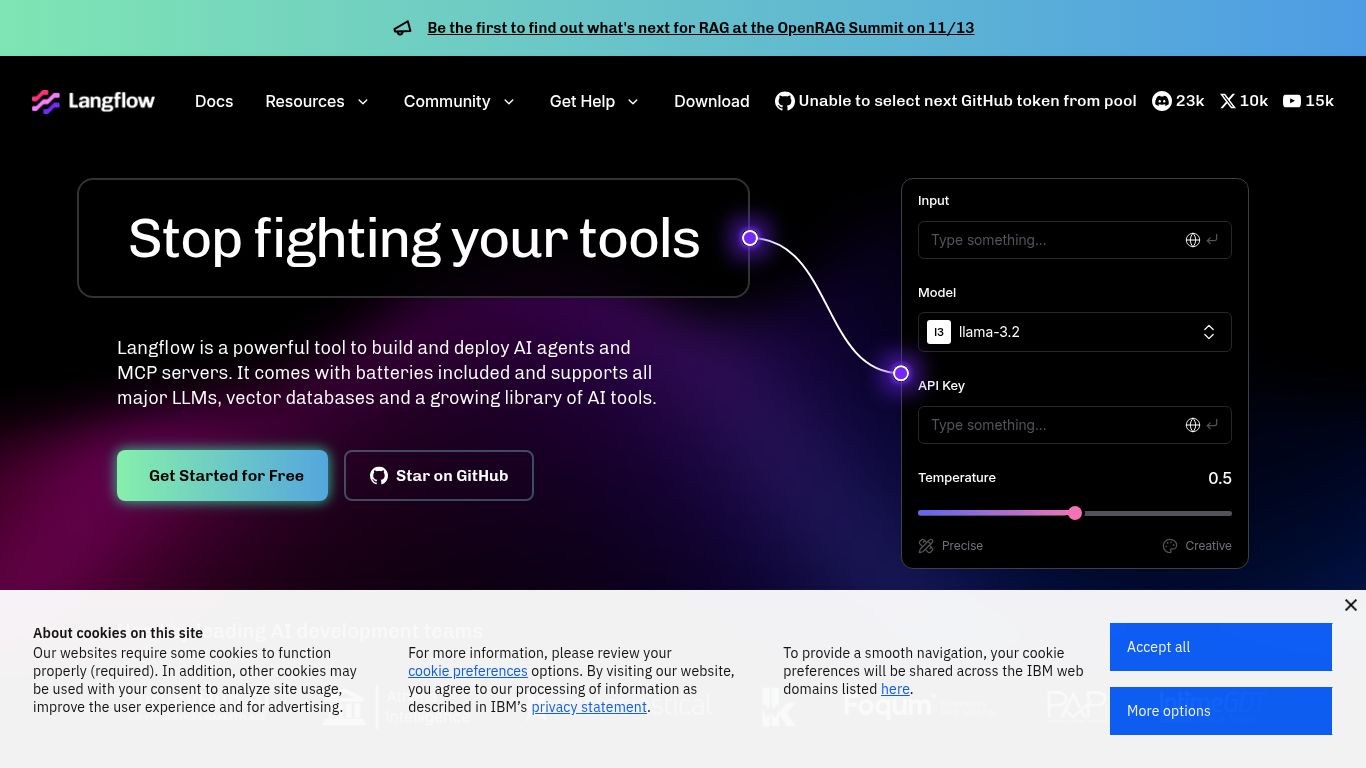
Welcome to the future of AI development! Langflow is a groundbreaking open-source platform designed with a graphical user interface (GUI) for the incredibly popular LangChain framework. Think of it as a visual playground where you can orchestrate complex AI pipelines, prototype sophisticated agents, and build LLM-powered applications with a simple drag-and-drop system. Developed by the Langflow community, its primary goal is to democratize and accelerate the creation of AI tools, making the power of Large Language Models accessible to everyone, from seasoned developers to enthusiastic beginners. It removes the steep learning curve of coding complex chains, allowing you to focus purely on innovation and logic.
While Langflow itself isn’t a direct content generator, its true power lies in its ability to orchestrate and connect various AI models and services. It acts as the central nervous system for your AI application, enabling a vast range of capabilities:
Multi-Modal Orchestration: Langflow allows you to integrate with external APIs for other modalities. You can design a flow where a user’s text prompt is used to generate a new prompt for an image generation model like DALL-E or Midjourney, or send text to a text-to-speech API like ElevenLabs to create audio. The possibilities are defined by the tools you connect.
API Integration & Automation: Seamlessly connect to any third-party API. This means you can build flows that fetch live weather data, search Google, interact with your CRM, or automate workflows across different software platforms, all triggered and managed through your LLM logic.
Rich Component Library: Langflow comes packed with a comprehensive set of pre-built components representing everything in the LangChain ecosystem—LLMs, prompt templates, memory modules, data loaders, agents, and tools.
Real-time Validation & Debugging: See your flow come to life as you build it. The interface provides instant feedback and helps you identify and fix issues on the fly, dramatically speeding up the development cycle.
Interactive Chat Interface: Test your application immediately within the Langflow UI. The built-in chat window lets you interact with your creation and see how it performs in real-time.
Exportable and Shareable Flows: Once you’re happy with your design, you can export it as a JSON file or even generate the equivalent Python code. This makes it easy to share your work or deploy it in a production environment.
Component Store & Extensibility: Discover and use custom components created by the community from the Langflow Store, or build your own to extend the platform’s functionality for your unique needs.
Langflow offers flexible pricing options to suit different needs, from individual hobbyists to large enterprises.
Price: Free. For developers and teams who want complete control, you can host Langflow on your own infrastructure at no cost. You are only responsible for your own hosting and API usage fees.
Price: Free. Perfect for individuals, students, and anyone looking to explore the platform. This tier provides a generous amount of credits and features to get you started building and experimenting without any financial commitment.
Price: Subscription-based. Aimed at professionals, startups, and small teams, the Pro plan offers significantly more usage credits, access to premium features, more projects, and priority support to help you build and scale your applications.
Price: Custom. Designed for large organizations with specific requirements for security, scalability, and support. This plan includes features like SSO, dedicated infrastructure, custom integrations, and white-glove support.
Prompt Engineers: To design, test, and manage intricate prompt chains and agentic workflows in a structured, visual environment.
Product Managers & UI/UX Designers: To build functional AI prototypes and proof-of-concepts to test ideas without needing to write a single line of code.
Startups & Innovators: To quickly build and iterate on AI-powered MVPs (Minimum Viable Products) and get to market faster.
Students & Hobbyists: As an exceptional educational tool for understanding the architecture of LLM applications in a hands-on, interactive way.
FlowiseAI is the most direct competitor to Langflow. Both are open-source, visual builders for LangChain. The choice often comes down to personal preference in user interface, the specific set of available components, and the activity level of their respective communities. Langflow is often praised for its polished UI and rapid feature development.
Dify is a more comprehensive LLMOps (Large Language Model Operations) platform that includes visual app building as one of its features. While Langflow focuses purely on the orchestration layer, Dify provides a more all-in-one solution with backend-as-a-service features, including data management and simple API deployment. Langflow offers deeper integration and granularity with the LangChain ecosystem.
The classic trade-off. Writing code directly in Python with the LangChain library offers maximum flexibility and control. Langflow, on the other hand, offers unparalleled speed for prototyping, visualization, and ease of use, especially for those less comfortable with coding. Many developers use Langflow to design the initial logic and then export the code for further customization.