AnythingLLM
Full-stack local chat app (desktop & server) with multi-user workspaces and RAG; solid base for private RP worlds.
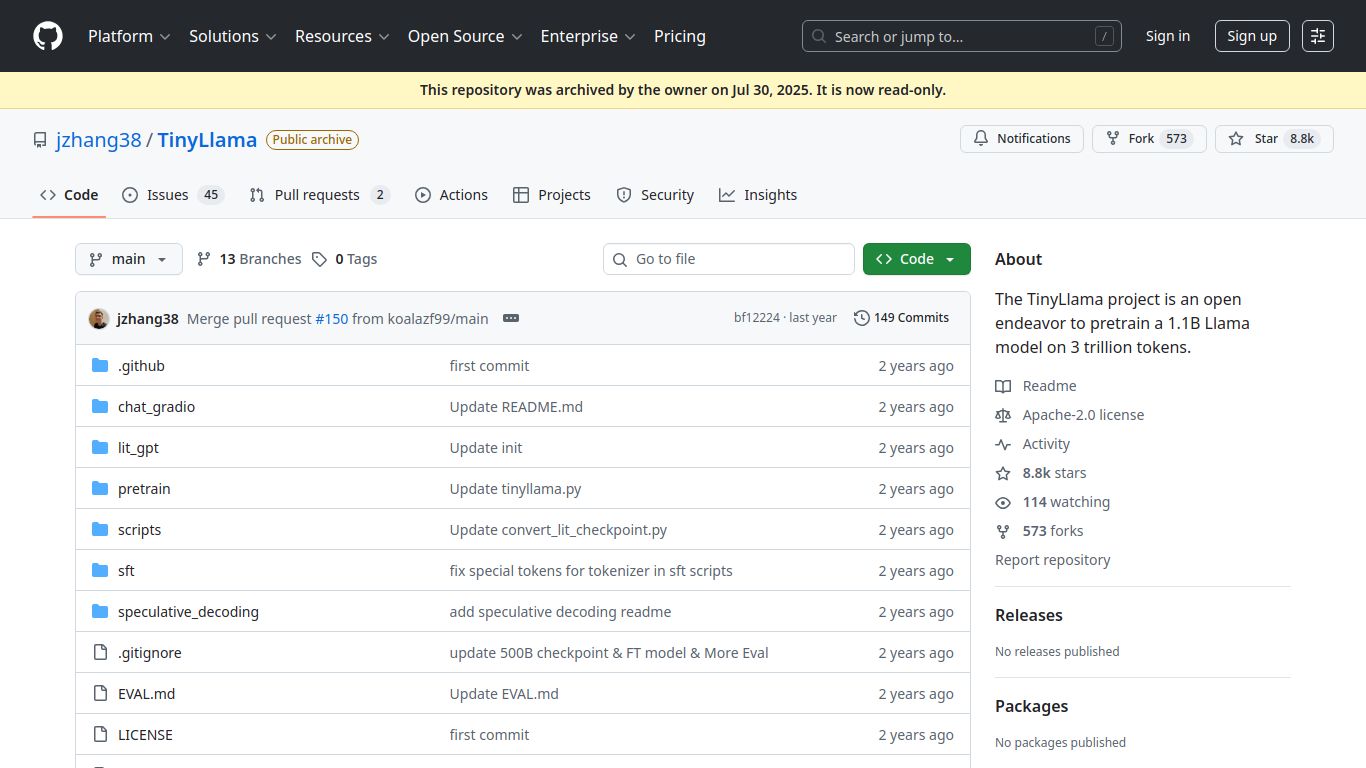
Compact 1.1B Llama-compatible model; popular GGUF quantizations make it fast on CPUs/GPUs locally.
Welcome to the next wave of AI accessibility! TinyLlama 1.1B, a groundbreaking open-source project, is here to prove that powerful language models don’t need to live in massive data centers. Developed by a dedicated research team, TinyLlama is a compact 1.1 billion parameter model designed to bring the magic of large language models (LLMs) to resource-constrained environments. It’s a lean, mean, text-generating machine, meticulously trained on an astounding 3 trillion tokens to deliver impressive performance in a remarkably small package. This project democratizes AI, making it possible for developers, hobbyists, and researchers to run a capable LLM on consumer-grade hardware.
It’s important to understand where TinyLlama shines. This model is a specialist, focusing exclusively on the vast world of text. It does not generate images, audio, or video. Instead, it channels all its power into linguistic tasks, offering strong capabilities in:
TinyLlama isn’t just another language model; its design philosophy offers a unique set of advantages that make it stand out from the crowd.
Here’s the simple and beautiful part: TinyLlama 1.1B is completely free. As an open-source project, there are no subscription plans, no usage tiers, and no hidden fees.
Your only cost is the hardware you choose to run it on. By eliminating expensive API calls to cloud-based services, TinyLlama can dramatically lower the operational costs of developing and deploying AI-powered applications.
This model’s accessibility makes it a perfect fit for a diverse range of users who were previously locked out of the LLM space due to high computational or financial barriers.
How does TinyLlama 1.1B stack up against the competition? It’s all about trade-offs between size, performance, and accessibility.
TinyLlama holds a strong position in the small model arena. It is often compared to Microsoft’s Phi-2 (a 2.7B model). While Phi-2 may have an edge in certain reasoning tasks due to its size and specialized training data, TinyLlama’s key advantage is its even smaller footprint and fully permissive license, making it more flexible for a wider range of commercial applications.
This isn’t a fair fight, nor is it meant to be. Larger models like Mistral 7B will undoubtedly provide more nuanced, accurate, and creative responses. However, they require significantly more VRAM and computational power, putting them out of reach for on-device applications or users with standard hardware. TinyLlama’s value proposition is not to outperform these giants, but to provide “good enough” or even great performance at a fraction of the resource cost. It’s the difference between needing a dedicated server and being able to run AI in your pocket.