Jigsaw Perspective API
Toxicity and harassment scoring for UGC; easy-to-integrate REST API.
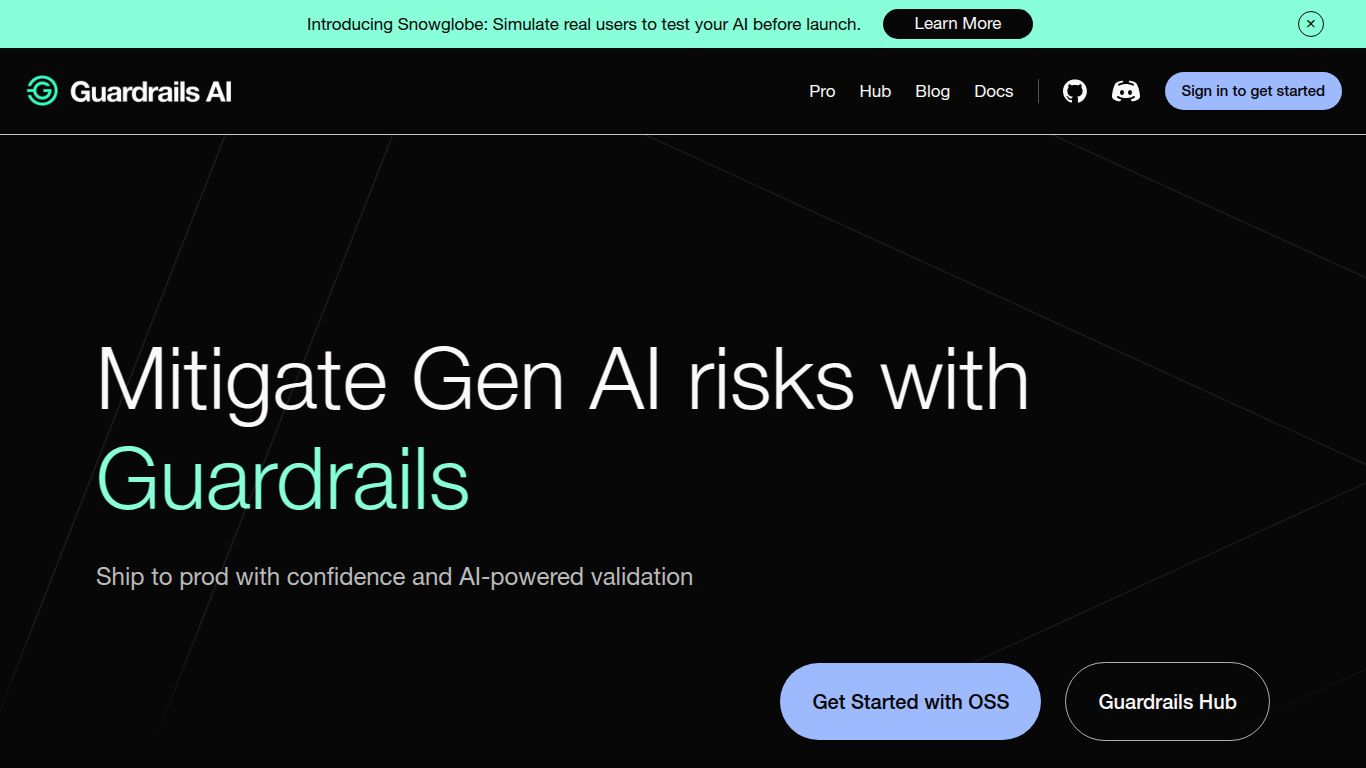
Open-source + managed framework for input/output checks and structured outputs.
Struggling with the chaotic and unpredictable nature of Large Language Models (LLMs)? Guardrails AI is an open-source framework designed to bring order to the chaos. Developed by Guardrails AI, this powerful tool acts as a safety net for your AI applications, ensuring that LLM outputs are not just accurate, but also properly structured, type-safe, and compliant with your specific rules. It’s the essential layer of trust and reliability between your application and the raw power of LLMs.
While Guardrails AI doesn’t generate content like images or videos itself, its core capability is to control and validate the outputs from models that do. It’s the ultimate quality control system for your AI’s responses. Here’s what it excels at managing:
Guardrails AI is packed with features designed to give developers granular control over their AI systems and ensure production-readiness.
Guardrails AI offers a flexible model that caters to everyone from individual developers to large enterprises. The core framework is always free, while the Guardrails Hub provides managed services and advanced features.
Free
Self-host and use the complete Guardrails library without any cost. Perfect for developers, researchers, and early-stage projects.
Free
Includes up to 10,000 monthly validations, access to the validator hub, and community support. Ideal for getting started with the managed service.
$49/month
Offers 100,000 monthly validations, faster performance, advanced analytics, and priority email support. Built for production applications.
Custom
Provides unlimited validations, dedicated infrastructure, enterprise-grade security (SOC2), and premium support. Tailored for large organizations.
This framework is a must-have for anyone serious about moving their AI projects from a fun prototype to a reliable, production-grade application.
How does Guardrails AI stack up against other tools in the ecosystem? Here’s a quick breakdown:
LangChain is a broad framework for building LLM applications, and its output parsers are one small part of it. Guardrails AI is hyper-focused on validation, offering more advanced features like multi-step validation, automatic re-prompting, and a richer library of validators specifically for this purpose.
NeMo Guardrails is primarily focused on controlling the conversational flow of AI chatbots, preventing them from going off-topic or discussing unsafe subjects. Guardrails AI is more general-purpose, focused on the structural and qualitative correctness of any LLM output, whether it’s for a chatbot, data extraction, or an API call.
Developed by Microsoft, TypeChat is excellent at ensuring LLM outputs conform to a specific TypeScript schema, making it great for generating structured JSON. Guardrails AI offers a similar capability but extends it with a much wider range of quality validations (e.g., sentiment, toxicity, fact-checking) and its powerful automatic correction loop, making it a more comprehensive validation solution.