Unleash AI Automation: A Deep Dive into Pipedream‘s OpenAI Integration
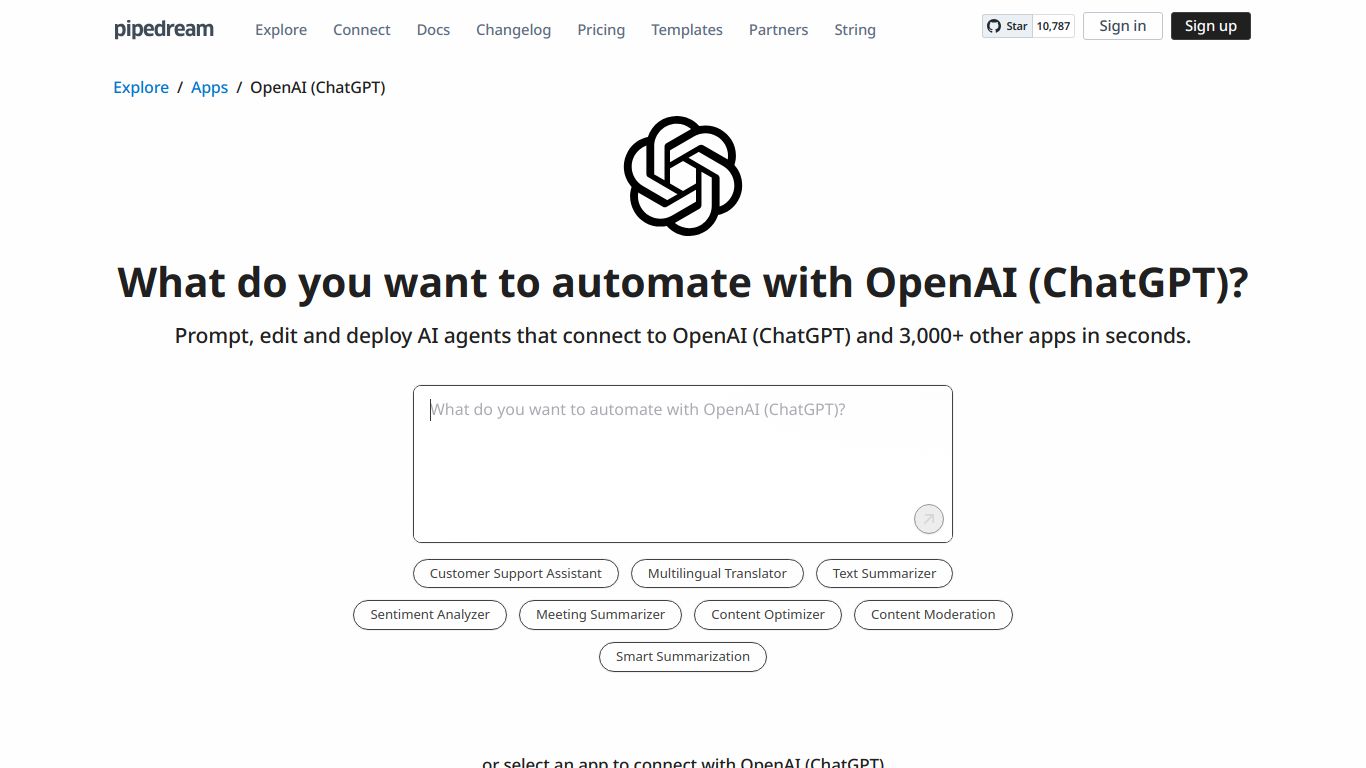
In the rapidly evolving world of artificial intelligence, connecting powerful models like OpenAI’s to your everyday applications can be a game-changer. Enter Pipedream, a developer-centric integration platform designed to help you build and run workflows with incredible speed and flexibility. Pipedream isn’t just another tool; it’s a serverless playground that allows you to automate tasks by linking triggers from one app to actions in another. Their dedicated OpenAI integration provides a vast library of pre-built workflows and components, making it astonishingly simple to inject the power of GPT-4, DALL-E, and other models directly into your projects, from simple Slack bots to complex data processing pipelines.
Core Capabilities: More Than Just a Connection
Pipedream acts as the ultimate bridge, enabling you to leverage OpenAI’s full spectrum of capabilities within automated workflows. It’s not about what Pipedream itself generates, but what it empowers you to build. The possibilities are virtually limitless.
- 📝 Advanced Text Generation: Automate the creation of anything from blog post drafts and social media captions to personalized email responses. You can set up a workflow where a new entry in a Google Sheet triggers GPT-4 to write a detailed product description and save it to your Airtable base.
- 🎨 On-Demand Image Generation: Connect to DALL-E to programmatically generate images. Imagine a workflow that takes new product names from a list and automatically creates unique logos or marketing visuals, then uploads them to a cloud storage service.
- 🤖 Intelligent Chatbots & Assistants: Build sophisticated, context-aware chatbots for Slack, Discord, or your own application using the OpenAI Assistants API. Pipedream handles the state management and API calls, so you can focus on the logic.
- 📊 Data Analysis & Summarization: Create workflows that automatically fetch reports, send the data to OpenAI for summarization or analysis, and then post the key insights into a team channel. Perfect for daily digests and business intelligence.
- 💻 Code Generation & Review: For development teams, Pipedream can automate parts of the coding lifecycle. For example, trigger a workflow on a new GitHub pull request to have OpenAI review the code for potential issues or suggest improvements.
Standout Features of the Platform
Pipedream’s core strength lies in its developer-first approach, offering unparalleled control and flexibility compared to no-code alternatives.
- Serverless Infrastructure: No servers, no hassle. Pipedream manages the entire backend, allowing your workflows to scale automatically based on demand. You only focus on your code and logic.
- Code-Level Customization: While there are thousands of pre-built actions, you are never limited. You can drop in your own Node.js or Python code at any step of a workflow, giving you complete control to interact with any API or transform data exactly as you need.
- Massive Component Library: With over 1,000 integrated apps and a huge collection of open-source triggers and actions, connecting OpenAI to services like Google, AWS, Slack, and Salesforce is just a few clicks away.
- Real-time Observability: Debugging is a breeze with live logs, detailed error reporting, and the ability to inspect every step of your workflow’s execution in real-time.
- Generous Free Tier: Pipedream offers a robust free plan that is perfect for experimenting, building personal projects, and even running low-volume production workflows without any cost.
Pricing: Scale As You Grow
Pipedream offers a transparent, usage-based pricing model that caters to everyone from hobbyists to large enterprises.
- Free Plan ($0/month): An excellent starting point for individuals and testing. It includes a generous number of invocations and compute time, perfect for getting your feet wet with AI automation.
- Developer Plan (Starts at ~$19/month): Aimed at professionals and small businesses, this plan offers significantly more invocations, longer execution times, and access to more advanced features like concurrency and execution history.
- Business Plan (Custom Pricing): Designed for teams and high-volume use cases, this tier provides dedicated support, advanced security features, team collaboration tools, and custom billing options to fit your organization’s needs.
Who Is It For? The Ideal User Profile
Pipedream is a versatile platform, but it resonates most strongly with those who have a bit of technical inclination.
- Developers & Software Engineers: The primary audience. Perfect for integrating AI into applications, building internal tools, and automating CI/CD pipelines.
- Marketing & Operations Automators: Tech-savvy marketers who want to build powerful content generation engines or sophisticated lead enrichment workflows that go beyond what typical no-code tools can offer.
- Indie Hackers & Solopreneurs: Ideal for building and running the backend of AI-powered micro-SaaS products or automating business operations single-handedly.
- Data Scientists & Analysts: A great tool for creating pipelines that automate data collection, cleaning, and AI-driven analysis for reporting.
Alternatives & How Pipedream Compares
While there are other players in the automation space, Pipedream carves out a unique niche.
- Zapier: The king of no-code automation. Zapier is incredibly user-friendly and perfect for non-technical users. Comparison: Zapier is simpler for basic tasks, while Pipedream offers infinitely more power and customization through code.
- Make (formerly Integromat): Known for its visual workflow builder and more complex logical capabilities than Zapier. It sits between pure no-code and code-centric platforms. Comparison: Make is more visual, but Pipedream’s serverless, code-native environment is often faster and more scalable for developers.
- n8n.io: A powerful, often self-hostable alternative that is also popular with developers. Comparison: Both are developer-friendly, but Pipedream’s fully-managed serverless platform offers a lower-maintenance experience compared to self-hosting n8n, while n8n provides data sovereignty for those who need it.